


OpenTable Sapphire Reservation Slots Guide (2026)
NCnextcard team
Advertiser Disclosure: nextcard may receive compensation from card issuers. Opinions expressed here are the author's alone, not those of any bank, credit card issuer, airlines or hotel chain. For the most up-to-date terms & conditions, refer to the official credit card application on the issuer's website.
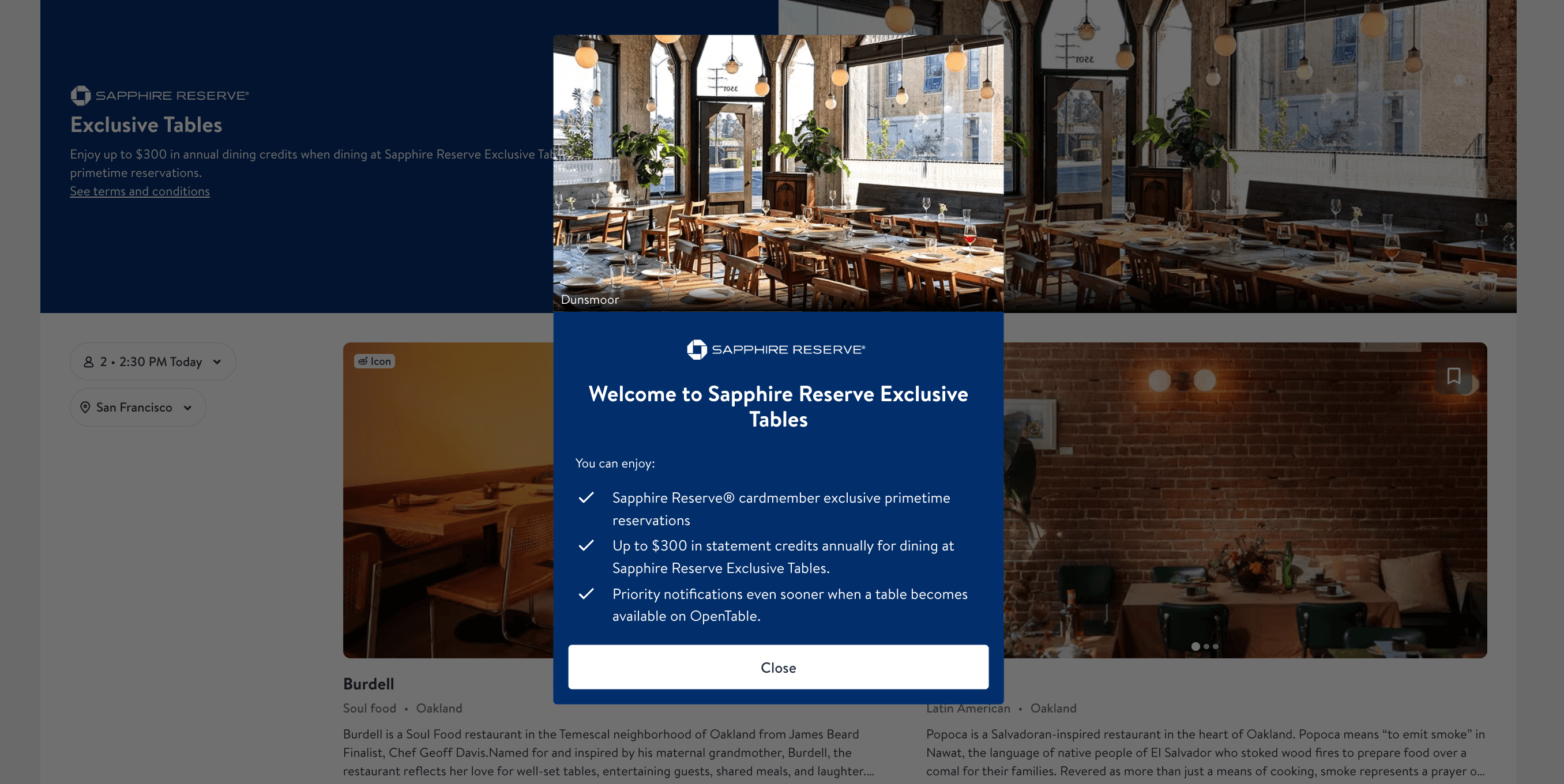
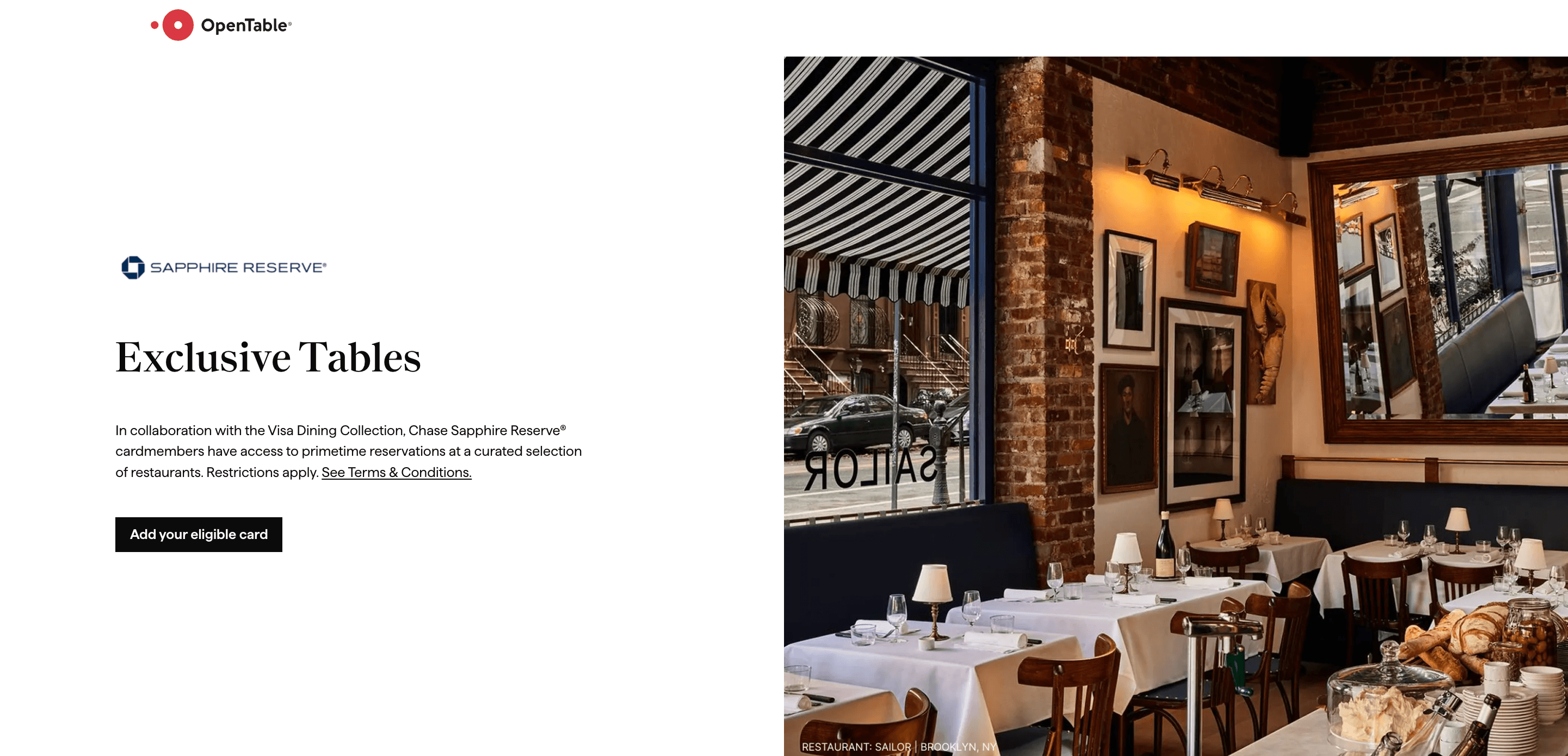
The Chase Sapphire Reserve Exclusive Tables program is a dining perk exclusively available to Chase Sapphire Reserve® cardholders.
It comes with two distinct benefits: first, you get access to prime-time reservations at high-end restaurants across the country through OpenTable. Second, (through your card) you get up to $300 in annual dining credits just for eating at a participating restaurant and paying with your Sapphire Reserve card. You don't need to book through the Exclusive Tables program to earn the credit.
And if you're considering getting this card, it currently has a great welcome bonus where you can earn 100,000 points after spending $6,000 in 3 months.
TL;DR
The Chase Sapphire Reserve Exclusive Tables program gives cardholders access to prime-time reservations at 440+ restaurants across 50+ US cities.
Cardholders receive up to $300 in annual dining credits ($150 per half-year) when dining at participating Exclusive Table restaurants (but no reservation is required)
Reservations are booked through OpenTable after linking your card to your account.
Credits only apply to dine-in purchases paid with your Sapphire Reserve card at participating restaurants (but again, no fancy reservation required)
As of October 2026, the program has grown to include 440+ restaurants across 50+ cities in the US.
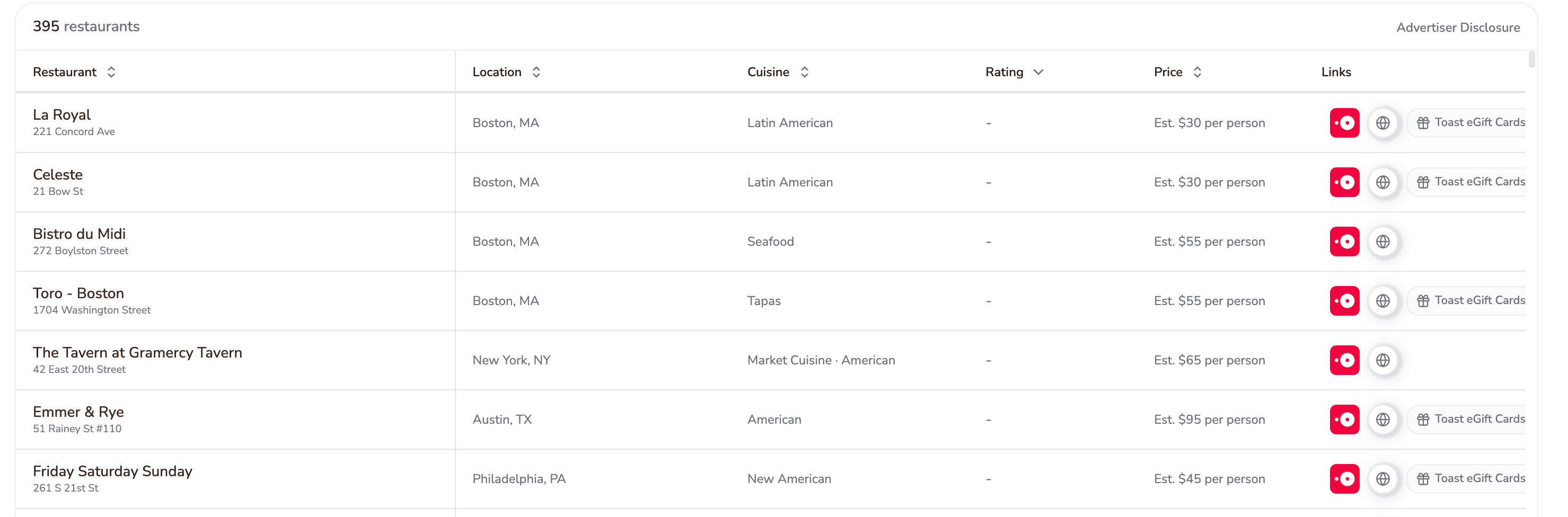
While we have the full list in the FAQs below & in this map, here are a few worth calling out:
Niku Steakhouse (San Francisco): known for their A5 Japanese wagyu and wood-fired steaks; grab a seat in front of the chef's area where you can watch them cook over the open wood grill
The Modern (New York): a two-Michelin-starred contemporary American restaurant inside the Museum of Modern Art, where Chef Thomas Allan's dining room overlooks MoMA's sculpture garden
Zitz Sum (Miami): Chef Pablo Zitzmann's Coral Gables restaurant blending Asian flavors with Italian technique; a Michelin Bib Gourmand recipient every year from 2022 through 2026 and a 2022 James Beard semifinalist for Best New Restaurant
While the program has expanded significantly since its original launch in late 2025, coverage is still concentrated in major metro areas, so you may have fewer options if you live in a smaller city. It's also worth noting that the credits are split semiannually, so you'll want to plan ahead to make sure you use them before each half-year window closes.
The program has two separate components, and each one works differently. Booking exclusive reservations requires linking your card through OpenTable, while earning the $300 annual dining credit is much simpler: just dine in at a participating restaurant and pay with your Sapphire Reserve card. Here's how to get started with each.
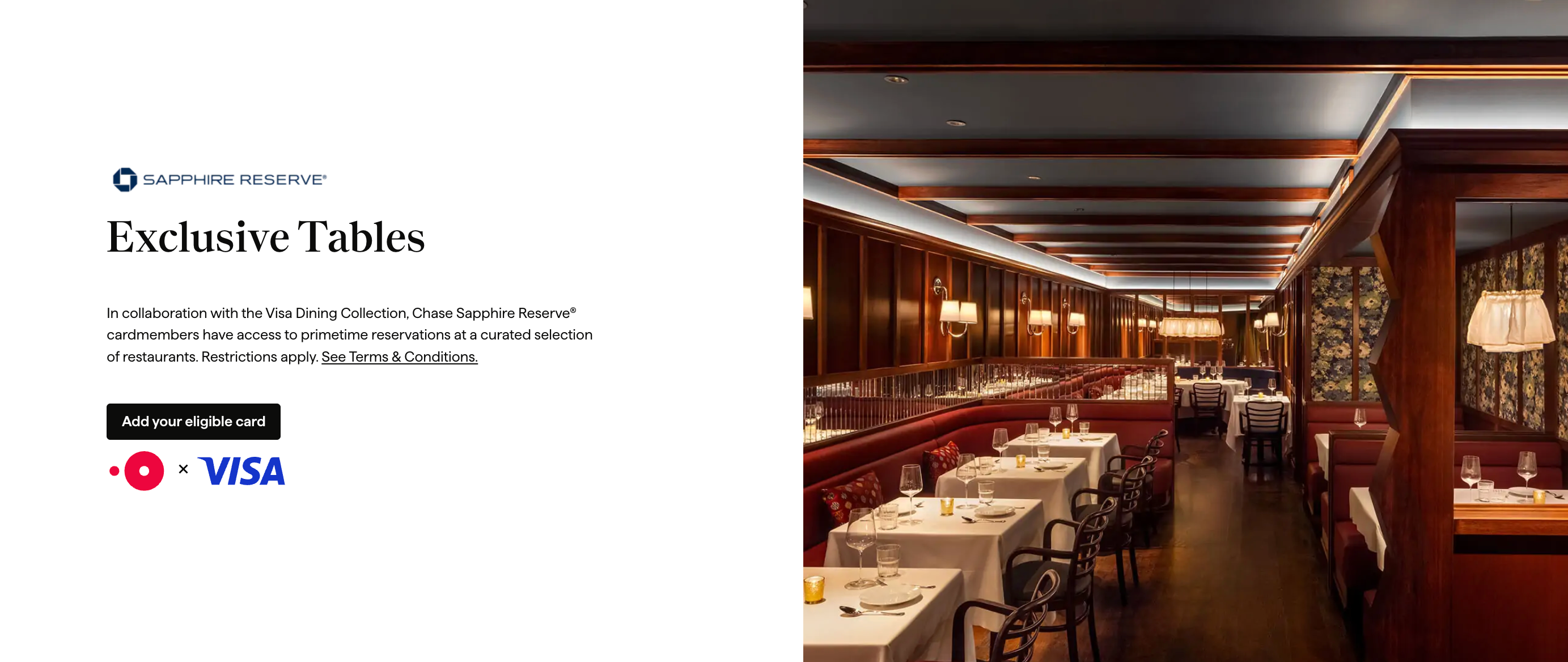
The reservation side of the program is designed to get you into popular restaurants during peak hours, like Friday and Saturday evening slots that would otherwise be fully booked. These aren't tables at random off-hours; they're genuine prime-time seats held specifically for Sapphire Reserve cardholders. To access them, you'll need to:
Login or create an account on the OpenTable site
Link your eligible card to the account
Once your membership is verified, you'll have immediate access to book prime-time reservations at participating restaurants through OpenTable.
The dining credit works separately from the reservation system. You don't need to book through Exclusive Tables or OpenTable to earn it. Just dine in at any participating restaurant and pay with your Sapphire Reserve card.
The $300 annual credit is split into two semiannual windows:
up to $150 in statement credits from January 1 through June 30, and
up to $150 from July 1 through December 31.
Make sure you remember that the credits are split up like this: you can only get up to $150 every half of the year. Credits also do not roll over from each half of the year.
The only requirements for earning the credit are that you dine in at a participating restaurant and pay with your Sapphire Reserve card. You don't need to book a reservation through Exclusive Tables or OpenTable. You do not need to select a fancy Sapphire slot. Delivery, takeout, merchandise, gift cards, and similar non-dine-in purchases do not qualify for statement credits.
For safe measures, just put down your physical Sapphire Reserve card when paying for the bill at the restaurant. It’s satisfying to hear the sound of the metal card against the table, anyway.
(That said, Apple Pay has traditionally worked pretty well for us).
The easiest way to check which restaurants near you qualify for the $300 dining credit is our CSR dining credit map, which plots every Exclusive Tables restaurant on an interactive map so you can search by city or zip code.
If you also hold cards with dining perks from other programs (Bilt Neighborhood Dining, Amex Resy, InKind, Rakuten, etc.), our MealMaxxer tool overlays 12+ dining rewards programs on a single map. It's a good way to spot restaurants where you can stack rewards from multiple cards on the same meal.
We also have city-specific breakdowns if you want a curated list for your area:
If you're weighing the Sapphire Reserve's dining credit against the American Express® Gold Card, here's a side-by-side look at how the two stack up:
Feature | Chase Sapphire Reserve Exclusive Tables | Amex Gold Dining Credits |
|---|---|---|
Annual Dining Credit | Up to $300 ($150 semiannually) | Up to $100 in Resy dining credits annually (up to $50 semiannually) |
Dining Rewards Rate | 3x points per dollar at restaurants | 4x points per dollar at restaurants (up to $50,000 spend/year) |
Restaurant Flexibility for Credit | 440+ US restaurants as of October 2026 | ~11,000 US-based Resy restaurants (plus eligible prepaid reservations and deposits at U.S. establishments through Tock, effective September 15, 2026; enrollment required) |
Annual Fee | $795 | $325 |
The Sapphire Reserve's dining credit is more concentrated: fewer partner restaurants, but you get (optional) exclusive reservation access and can apply the full credit toward a single meal. The Amex Gold spreads its dining value across more merchants and earns a higher points multiplier on restaurant spend, but none of its credits come with reservation perks.
In practice, if you eat at upscale restaurants a few times a year and want to offset the bill in bigger chunks, the CSR's $150 semiannual credit goes further per meal. If you dine out frequently at a wider range of places and have smaller bills, the broader Resy network is hard to beat.
With this new dining credit, it is clear that Chase is catering towards premium spenders who don't mind splurging and eating out at luxurious restaurants. Bills at many of these restaurants can easily rack up hundreds of dollars. For example, at the Ogawa Sushi & Kappo Omakase restaurant in Philadelphia, the 23-course omakase experience costs $200 a person as of 2026.
One of the semiannual credits won’t even cover the cost for a single person to get the omakase experience. It is likely that only people who can afford premium dining experiences in the higher price range will choose to use the Sapphire Reserve Exclusive Tables program.
If you dine out occasionally or frequently at these kind of restaurants, you'll get solid value from both sides of the program: the $300 credit is easy money back just for paying with your card, and the exclusive reservation access is a nice bonus for scoring prime-time tables at popular spots.
If you're like me, and you rarely go out for premium cuisine, the up to $300 credit is still worth using for a couple of nice dinners a year. The reservation perk is less relevant if you're not booking at these restaurants regularly, but the credit alone makes the program worthwhile.
After linking your card to your OpenTable account, you can browse and book prime-time reservations at participating restaurants directly through OpenTable. Look for the "Exclusive Tables" label when searching for availability. Remember: you do not need a reservation to use the Sapphire Reserve's dining credit.
No. The credit only applies to dine-in purchases at participating Exclusive Tables restaurants, but you don't need to book through the Exclusive Tables program or OpenTable to earn it.
Just dine in and pay with your Sapphire Reserve card.
Unused credits do not roll over. If you don't spend the full $150 by June 30 or December 31, you lose the remaining balance for that half of the year. Plan your dining accordingly to get the full $300 in annual value.
Yes. When you pay with your Sapphire Reserve at a participating Exclusive Tables restaurant, you earn 3x Ultimate Rewards points per dollar on the bill after the credit has been applied.
Yes. Authorized users can access Exclusive Tables by linking their Sapphire Reserve card to their own OpenTable account. However, the up to $300 annual dining credit is shared across the card account rather than provided separately to each authorized user.
Advertiser Disclosure: nextcard may receive compensation from card issuers. Opinions expressed here are the author's alone, not those of any bank, credit card issuer, airlines or hotel chain. For the most up-to-date terms & conditions, refer to the official credit card application on the issuer's website.
The Chase Sapphire Reserve Exclusive Tables program is a dining perk exclusively available to Chase Sapphire Reserve® cardholders.
It comes with two distinct benefits: first, you get access to prime-time reservations at high-end restaurants across the country through OpenTable. Second, (through your card) you get up to $300 in annual dining credits just for eating at a participating restaurant and paying with your Sapphire Reserve card. You don't need to book through the Exclusive Tables program to earn the credit.
And if you're considering getting this card, it currently has a great welcome bonus where you can earn 100,000 points after spending $6,000 in 3 months.
TL;DR
The Chase Sapphire Reserve Exclusive Tables program gives cardholders access to prime-time reservations at 440+ restaurants across 50+ US cities.
Cardholders receive up to $300 in annual dining credits ($150 per half-year) when dining at participating Exclusive Table restaurants (but no reservation is required)
Reservations are booked through OpenTable after linking your card to your account.
Credits only apply to dine-in purchases paid with your Sapphire Reserve card at participating restaurants (but again, no fancy reservation required)
As of October 2026, the program has grown to include 440+ restaurants across 50+ cities in the US.
While we have the full list in the FAQs below & in this map, here are a few worth calling out:
Niku Steakhouse (San Francisco): known for their A5 Japanese wagyu and wood-fired steaks; grab a seat in front of the chef's area where you can watch them cook over the open wood grill
The Modern (New York): a two-Michelin-starred contemporary American restaurant inside the Museum of Modern Art, where Chef Thomas Allan's dining room overlooks MoMA's sculpture garden
Zitz Sum (Miami): Chef Pablo Zitzmann's Coral Gables restaurant blending Asian flavors with Italian technique; a Michelin Bib Gourmand recipient every year from 2022 through 2026 and a 2022 James Beard semifinalist for Best New Restaurant
While the program has expanded significantly since its original launch in late 2025, coverage is still concentrated in major metro areas, so you may have fewer options if you live in a smaller city. It's also worth noting that the credits are split semiannually, so you'll want to plan ahead to make sure you use them before each half-year window closes.
The program has two separate components, and each one works differently. Booking exclusive reservations requires linking your card through OpenTable, while earning the $300 annual dining credit is much simpler: just dine in at a participating restaurant and pay with your Sapphire Reserve card. Here's how to get started with each.
The reservation side of the program is designed to get you into popular restaurants during peak hours, like Friday and Saturday evening slots that would otherwise be fully booked. These aren't tables at random off-hours; they're genuine prime-time seats held specifically for Sapphire Reserve cardholders. To access them, you'll need to:
Login or create an account on the OpenTable site
Link your eligible card to the account
Once your membership is verified, you'll have immediate access to book prime-time reservations at participating restaurants through OpenTable.
The dining credit works separately from the reservation system. You don't need to book through Exclusive Tables or OpenTable to earn it. Just dine in at any participating restaurant and pay with your Sapphire Reserve card.
The $300 annual credit is split into two semiannual windows:
up to $150 in statement credits from January 1 through June 30, and
up to $150 from July 1 through December 31.
Make sure you remember that the credits are split up like this: you can only get up to $150 every half of the year. Credits also do not roll over from each half of the year.
The only requirements for earning the credit are that you dine in at a participating restaurant and pay with your Sapphire Reserve card. You don't need to book a reservation through Exclusive Tables or OpenTable. You do not need to select a fancy Sapphire slot. Delivery, takeout, merchandise, gift cards, and similar non-dine-in purchases do not qualify for statement credits.
For safe measures, just put down your physical Sapphire Reserve card when paying for the bill at the restaurant. It’s satisfying to hear the sound of the metal card against the table, anyway.
(That said, Apple Pay has traditionally worked pretty well for us).
The easiest way to check which restaurants near you qualify for the $300 dining credit is our CSR dining credit map, which plots every Exclusive Tables restaurant on an interactive map so you can search by city or zip code.
If you also hold cards with dining perks from other programs (Bilt Neighborhood Dining, Amex Resy, InKind, Rakuten, etc.), our MealMaxxer tool overlays 12+ dining rewards programs on a single map. It's a good way to spot restaurants where you can stack rewards from multiple cards on the same meal.
We also have city-specific breakdowns if you want a curated list for your area:
If you're weighing the Sapphire Reserve's dining credit against the American Express® Gold Card, here's a side-by-side look at how the two stack up:
Feature | Chase Sapphire Reserve Exclusive Tables | Amex Gold Dining Credits |
|---|---|---|
Annual Dining Credit | Up to $300 ($150 semiannually) | Up to $100 in Resy dining credits annually (up to $50 semiannually) |
Dining Rewards Rate | 3x points per dollar at restaurants | 4x points per dollar at restaurants (up to $50,000 spend/year) |
Restaurant Flexibility for Credit | 440+ US restaurants as of October 2026 | ~11,000 US-based Resy restaurants (plus eligible prepaid reservations and deposits at U.S. establishments through Tock, effective September 15, 2026; enrollment required) |
Annual Fee | $795 | $325 |
The Sapphire Reserve's dining credit is more concentrated: fewer partner restaurants, but you get (optional) exclusive reservation access and can apply the full credit toward a single meal. The Amex Gold spreads its dining value across more merchants and earns a higher points multiplier on restaurant spend, but none of its credits come with reservation perks.
In practice, if you eat at upscale restaurants a few times a year and want to offset the bill in bigger chunks, the CSR's $150 semiannual credit goes further per meal. If you dine out frequently at a wider range of places and have smaller bills, the broader Resy network is hard to beat.
With this new dining credit, it is clear that Chase is catering towards premium spenders who don't mind splurging and eating out at luxurious restaurants. Bills at many of these restaurants can easily rack up hundreds of dollars. For example, at the Ogawa Sushi & Kappo Omakase restaurant in Philadelphia, the 23-course omakase experience costs $200 a person as of 2026.
One of the semiannual credits won’t even cover the cost for a single person to get the omakase experience. It is likely that only people who can afford premium dining experiences in the higher price range will choose to use the Sapphire Reserve Exclusive Tables program.
If you dine out occasionally or frequently at these kind of restaurants, you'll get solid value from both sides of the program: the $300 credit is easy money back just for paying with your card, and the exclusive reservation access is a nice bonus for scoring prime-time tables at popular spots.
If you're like me, and you rarely go out for premium cuisine, the up to $300 credit is still worth using for a couple of nice dinners a year. The reservation perk is less relevant if you're not booking at these restaurants regularly, but the credit alone makes the program worthwhile.
After linking your card to your OpenTable account, you can browse and book prime-time reservations at participating restaurants directly through OpenTable. Look for the "Exclusive Tables" label when searching for availability. Remember: you do not need a reservation to use the Sapphire Reserve's dining credit.
No. The credit only applies to dine-in purchases at participating Exclusive Tables restaurants, but you don't need to book through the Exclusive Tables program or OpenTable to earn it.
Just dine in and pay with your Sapphire Reserve card.
Unused credits do not roll over. If you don't spend the full $150 by June 30 or December 31, you lose the remaining balance for that half of the year. Plan your dining accordingly to get the full $300 in annual value.
Yes. When you pay with your Sapphire Reserve at a participating Exclusive Tables restaurant, you earn 3x Ultimate Rewards points per dollar on the bill after the credit has been applied.
Yes. Authorized users can access Exclusive Tables by linking their Sapphire Reserve card to their own OpenTable account. However, the up to $300 annual dining credit is shared across the card account rather than provided separately to each authorized user.
Advertiser Disclosure: nextcard may receive compensation from card issuers. Opinions expressed here are the author's alone, not those of any bank, credit card issuer, airlines or hotel chain. For the most up-to-date terms & conditions, refer to the official credit card application on the issuer's website.
The Chase Sapphire Reserve Exclusive Tables program is a dining perk exclusively available to Chase Sapphire Reserve® cardholders.
It comes with two distinct benefits: first, you get access to prime-time reservations at high-end restaurants across the country through OpenTable. Second, (through your card) you get up to $300 in annual dining credits just for eating at a participating restaurant and paying with your Sapphire Reserve card. You don't need to book through the Exclusive Tables program to earn the credit.
And if you're considering getting this card, it currently has a great welcome bonus where you can earn 100,000 points after spending $6,000 in 3 months.
TL;DR
The Chase Sapphire Reserve Exclusive Tables program gives cardholders access to prime-time reservations at 440+ restaurants across 50+ US cities.
Cardholders receive up to $300 in annual dining credits ($150 per half-year) when dining at participating Exclusive Table restaurants (but no reservation is required)
Reservations are booked through OpenTable after linking your card to your account.
Credits only apply to dine-in purchases paid with your Sapphire Reserve card at participating restaurants (but again, no fancy reservation required)
As of October 2026, the program has grown to include 440+ restaurants across 50+ cities in the US.
While we have the full list in the FAQs below & in this map, here are a few worth calling out:
Niku Steakhouse (San Francisco): known for their A5 Japanese wagyu and wood-fired steaks; grab a seat in front of the chef's area where you can watch them cook over the open wood grill
The Modern (New York): a two-Michelin-starred contemporary American restaurant inside the Museum of Modern Art, where Chef Thomas Allan's dining room overlooks MoMA's sculpture garden
Zitz Sum (Miami): Chef Pablo Zitzmann's Coral Gables restaurant blending Asian flavors with Italian technique; a Michelin Bib Gourmand recipient every year from 2022 through 2026 and a 2022 James Beard semifinalist for Best New Restaurant
While the program has expanded significantly since its original launch in late 2025, coverage is still concentrated in major metro areas, so you may have fewer options if you live in a smaller city. It's also worth noting that the credits are split semiannually, so you'll want to plan ahead to make sure you use them before each half-year window closes.
The program has two separate components, and each one works differently. Booking exclusive reservations requires linking your card through OpenTable, while earning the $300 annual dining credit is much simpler: just dine in at a participating restaurant and pay with your Sapphire Reserve card. Here's how to get started with each.
The reservation side of the program is designed to get you into popular restaurants during peak hours, like Friday and Saturday evening slots that would otherwise be fully booked. These aren't tables at random off-hours; they're genuine prime-time seats held specifically for Sapphire Reserve cardholders. To access them, you'll need to:
Login or create an account on the OpenTable site
Link your eligible card to the account
Once your membership is verified, you'll have immediate access to book prime-time reservations at participating restaurants through OpenTable.
The dining credit works separately from the reservation system. You don't need to book through Exclusive Tables or OpenTable to earn it. Just dine in at any participating restaurant and pay with your Sapphire Reserve card.
The $300 annual credit is split into two semiannual windows:
up to $150 in statement credits from January 1 through June 30, and
up to $150 from July 1 through December 31.
Make sure you remember that the credits are split up like this: you can only get up to $150 every half of the year. Credits also do not roll over from each half of the year.
The only requirements for earning the credit are that you dine in at a participating restaurant and pay with your Sapphire Reserve card. You don't need to book a reservation through Exclusive Tables or OpenTable. You do not need to select a fancy Sapphire slot. Delivery, takeout, merchandise, gift cards, and similar non-dine-in purchases do not qualify for statement credits.
For safe measures, just put down your physical Sapphire Reserve card when paying for the bill at the restaurant. It’s satisfying to hear the sound of the metal card against the table, anyway.
(That said, Apple Pay has traditionally worked pretty well for us).
The easiest way to check which restaurants near you qualify for the $300 dining credit is our CSR dining credit map, which plots every Exclusive Tables restaurant on an interactive map so you can search by city or zip code.
If you also hold cards with dining perks from other programs (Bilt Neighborhood Dining, Amex Resy, InKind, Rakuten, etc.), our MealMaxxer tool overlays 12+ dining rewards programs on a single map. It's a good way to spot restaurants where you can stack rewards from multiple cards on the same meal.
We also have city-specific breakdowns if you want a curated list for your area:
If you're weighing the Sapphire Reserve's dining credit against the American Express® Gold Card, here's a side-by-side look at how the two stack up:
Feature | Chase Sapphire Reserve Exclusive Tables | Amex Gold Dining Credits |
|---|---|---|
Annual Dining Credit | Up to $300 ($150 semiannually) | Up to $100 in Resy dining credits annually (up to $50 semiannually) |
Dining Rewards Rate | 3x points per dollar at restaurants | 4x points per dollar at restaurants (up to $50,000 spend/year) |
Restaurant Flexibility for Credit | 440+ US restaurants as of October 2026 | ~11,000 US-based Resy restaurants (plus eligible prepaid reservations and deposits at U.S. establishments through Tock, effective September 15, 2026; enrollment required) |
Annual Fee | $795 | $325 |
The Sapphire Reserve's dining credit is more concentrated: fewer partner restaurants, but you get (optional) exclusive reservation access and can apply the full credit toward a single meal. The Amex Gold spreads its dining value across more merchants and earns a higher points multiplier on restaurant spend, but none of its credits come with reservation perks.
In practice, if you eat at upscale restaurants a few times a year and want to offset the bill in bigger chunks, the CSR's $150 semiannual credit goes further per meal. If you dine out frequently at a wider range of places and have smaller bills, the broader Resy network is hard to beat.
With this new dining credit, it is clear that Chase is catering towards premium spenders who don't mind splurging and eating out at luxurious restaurants. Bills at many of these restaurants can easily rack up hundreds of dollars. For example, at the Ogawa Sushi & Kappo Omakase restaurant in Philadelphia, the 23-course omakase experience costs $200 a person as of 2026.
One of the semiannual credits won’t even cover the cost for a single person to get the omakase experience. It is likely that only people who can afford premium dining experiences in the higher price range will choose to use the Sapphire Reserve Exclusive Tables program.
If you dine out occasionally or frequently at these kind of restaurants, you'll get solid value from both sides of the program: the $300 credit is easy money back just for paying with your card, and the exclusive reservation access is a nice bonus for scoring prime-time tables at popular spots.
If you're like me, and you rarely go out for premium cuisine, the up to $300 credit is still worth using for a couple of nice dinners a year. The reservation perk is less relevant if you're not booking at these restaurants regularly, but the credit alone makes the program worthwhile.
After linking your card to your OpenTable account, you can browse and book prime-time reservations at participating restaurants directly through OpenTable. Look for the "Exclusive Tables" label when searching for availability. Remember: you do not need a reservation to use the Sapphire Reserve's dining credit.
No. The credit only applies to dine-in purchases at participating Exclusive Tables restaurants, but you don't need to book through the Exclusive Tables program or OpenTable to earn it.
Just dine in and pay with your Sapphire Reserve card.
Unused credits do not roll over. If you don't spend the full $150 by June 30 or December 31, you lose the remaining balance for that half of the year. Plan your dining accordingly to get the full $300 in annual value.
Yes. When you pay with your Sapphire Reserve at a participating Exclusive Tables restaurant, you earn 3x Ultimate Rewards points per dollar on the bill after the credit has been applied.
Yes. Authorized users can access Exclusive Tables by linking their Sapphire Reserve card to their own OpenTable account. However, the up to $300 annual dining credit is shared across the card account rather than provided separately to each authorized user.
Advertiser Disclosure: nextcard may receive compensation from card issuers. Opinions expressed here are the author's alone, not those of any bank, credit card issuer, airlines or hotel chain. For the most up-to-date terms & conditions, refer to the official credit card application on the issuer's website.
The Chase Sapphire Reserve Exclusive Tables program is a dining perk exclusively available to Chase Sapphire Reserve® cardholders.
It comes with two distinct benefits: first, you get access to prime-time reservations at high-end restaurants across the country through OpenTable. Second, (through your card) you get up to $300 in annual dining credits just for eating at a participating restaurant and paying with your Sapphire Reserve card. You don't need to book through the Exclusive Tables program to earn the credit.
And if you're considering getting this card, it currently has a great welcome bonus where you can earn 100,000 points after spending $6,000 in 3 months.
TL;DR
The Chase Sapphire Reserve Exclusive Tables program gives cardholders access to prime-time reservations at 440+ restaurants across 50+ US cities.
Cardholders receive up to $300 in annual dining credits ($150 per half-year) when dining at participating Exclusive Table restaurants (but no reservation is required)
Reservations are booked through OpenTable after linking your card to your account.
Credits only apply to dine-in purchases paid with your Sapphire Reserve card at participating restaurants (but again, no fancy reservation required)
As of October 2026, the program has grown to include 440+ restaurants across 50+ cities in the US.
While we have the full list in the FAQs below & in this map, here are a few worth calling out:
Niku Steakhouse (San Francisco): known for their A5 Japanese wagyu and wood-fired steaks; grab a seat in front of the chef's area where you can watch them cook over the open wood grill
The Modern (New York): a two-Michelin-starred contemporary American restaurant inside the Museum of Modern Art, where Chef Thomas Allan's dining room overlooks MoMA's sculpture garden
Zitz Sum (Miami): Chef Pablo Zitzmann's Coral Gables restaurant blending Asian flavors with Italian technique; a Michelin Bib Gourmand recipient every year from 2022 through 2026 and a 2022 James Beard semifinalist for Best New Restaurant
While the program has expanded significantly since its original launch in late 2025, coverage is still concentrated in major metro areas, so you may have fewer options if you live in a smaller city. It's also worth noting that the credits are split semiannually, so you'll want to plan ahead to make sure you use them before each half-year window closes.
The program has two separate components, and each one works differently. Booking exclusive reservations requires linking your card through OpenTable, while earning the $300 annual dining credit is much simpler: just dine in at a participating restaurant and pay with your Sapphire Reserve card. Here's how to get started with each.
The reservation side of the program is designed to get you into popular restaurants during peak hours, like Friday and Saturday evening slots that would otherwise be fully booked. These aren't tables at random off-hours; they're genuine prime-time seats held specifically for Sapphire Reserve cardholders. To access them, you'll need to:
Login or create an account on the OpenTable site
Link your eligible card to the account
Once your membership is verified, you'll have immediate access to book prime-time reservations at participating restaurants through OpenTable.
The dining credit works separately from the reservation system. You don't need to book through Exclusive Tables or OpenTable to earn it. Just dine in at any participating restaurant and pay with your Sapphire Reserve card.
The $300 annual credit is split into two semiannual windows:
up to $150 in statement credits from January 1 through June 30, and
up to $150 from July 1 through December 31.
Make sure you remember that the credits are split up like this: you can only get up to $150 every half of the year. Credits also do not roll over from each half of the year.
The only requirements for earning the credit are that you dine in at a participating restaurant and pay with your Sapphire Reserve card. You don't need to book a reservation through Exclusive Tables or OpenTable. You do not need to select a fancy Sapphire slot. Delivery, takeout, merchandise, gift cards, and similar non-dine-in purchases do not qualify for statement credits.
For safe measures, just put down your physical Sapphire Reserve card when paying for the bill at the restaurant. It’s satisfying to hear the sound of the metal card against the table, anyway.
(That said, Apple Pay has traditionally worked pretty well for us).
The easiest way to check which restaurants near you qualify for the $300 dining credit is our CSR dining credit map, which plots every Exclusive Tables restaurant on an interactive map so you can search by city or zip code.
If you also hold cards with dining perks from other programs (Bilt Neighborhood Dining, Amex Resy, InKind, Rakuten, etc.), our MealMaxxer tool overlays 12+ dining rewards programs on a single map. It's a good way to spot restaurants where you can stack rewards from multiple cards on the same meal.
We also have city-specific breakdowns if you want a curated list for your area:
If you're weighing the Sapphire Reserve's dining credit against the American Express® Gold Card, here's a side-by-side look at how the two stack up:
Feature | Chase Sapphire Reserve Exclusive Tables | Amex Gold Dining Credits |
|---|---|---|
Annual Dining Credit | Up to $300 ($150 semiannually) | Up to $100 in Resy dining credits annually (up to $50 semiannually) |
Dining Rewards Rate | 3x points per dollar at restaurants | 4x points per dollar at restaurants (up to $50,000 spend/year) |
Restaurant Flexibility for Credit | 440+ US restaurants as of October 2026 | ~11,000 US-based Resy restaurants (plus eligible prepaid reservations and deposits at U.S. establishments through Tock, effective September 15, 2026; enrollment required) |
Annual Fee | $795 | $325 |
The Sapphire Reserve's dining credit is more concentrated: fewer partner restaurants, but you get (optional) exclusive reservation access and can apply the full credit toward a single meal. The Amex Gold spreads its dining value across more merchants and earns a higher points multiplier on restaurant spend, but none of its credits come with reservation perks.
In practice, if you eat at upscale restaurants a few times a year and want to offset the bill in bigger chunks, the CSR's $150 semiannual credit goes further per meal. If you dine out frequently at a wider range of places and have smaller bills, the broader Resy network is hard to beat.
With this new dining credit, it is clear that Chase is catering towards premium spenders who don't mind splurging and eating out at luxurious restaurants. Bills at many of these restaurants can easily rack up hundreds of dollars. For example, at the Ogawa Sushi & Kappo Omakase restaurant in Philadelphia, the 23-course omakase experience costs $200 a person as of 2026.
One of the semiannual credits won’t even cover the cost for a single person to get the omakase experience. It is likely that only people who can afford premium dining experiences in the higher price range will choose to use the Sapphire Reserve Exclusive Tables program.
If you dine out occasionally or frequently at these kind of restaurants, you'll get solid value from both sides of the program: the $300 credit is easy money back just for paying with your card, and the exclusive reservation access is a nice bonus for scoring prime-time tables at popular spots.
If you're like me, and you rarely go out for premium cuisine, the up to $300 credit is still worth using for a couple of nice dinners a year. The reservation perk is less relevant if you're not booking at these restaurants regularly, but the credit alone makes the program worthwhile.
After linking your card to your OpenTable account, you can browse and book prime-time reservations at participating restaurants directly through OpenTable. Look for the "Exclusive Tables" label when searching for availability. Remember: you do not need a reservation to use the Sapphire Reserve's dining credit.
No. The credit only applies to dine-in purchases at participating Exclusive Tables restaurants, but you don't need to book through the Exclusive Tables program or OpenTable to earn it.
Just dine in and pay with your Sapphire Reserve card.
Unused credits do not roll over. If you don't spend the full $150 by June 30 or December 31, you lose the remaining balance for that half of the year. Plan your dining accordingly to get the full $300 in annual value.
Yes. When you pay with your Sapphire Reserve at a participating Exclusive Tables restaurant, you earn 3x Ultimate Rewards points per dollar on the bill after the credit has been applied.
Yes. Authorized users can access Exclusive Tables by linking their Sapphire Reserve card to their own OpenTable account. However, the up to $300 annual dining credit is shared across the card account rather than provided separately to each authorized user.

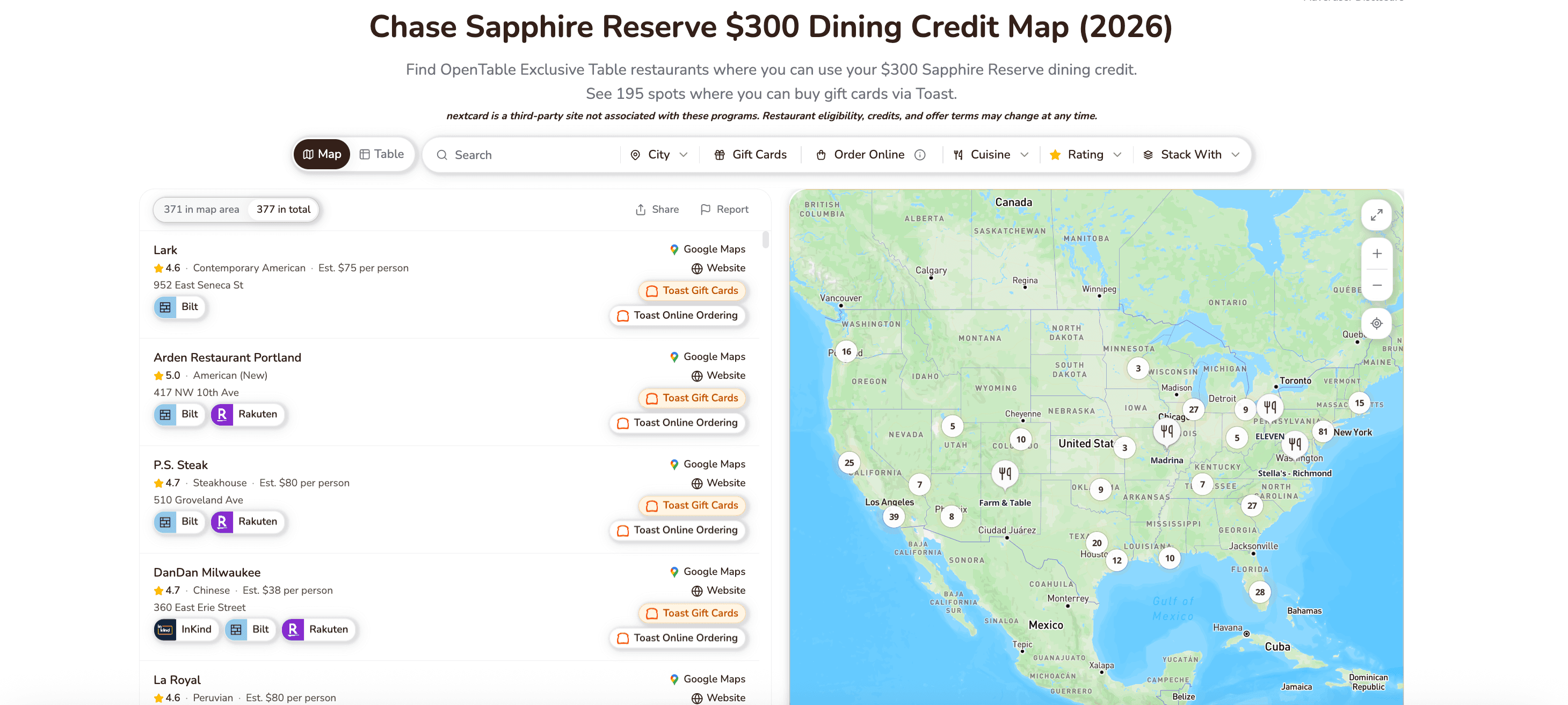
Find OpenTable Exclusive Table restaurants where you can use your $300 Sapphire Reserve dining credit. See 150+ spots where you can buy gift cards via Toast.
Interactive tool
Open tool
Find OpenTable Exclusive Table restaurants where you can use your $300 Sapphire Reserve dining credit. See 150+ spots where you can buy gift cards via Toast.
Interactive tool
Open tool