


(Live) United Airlines MileagePlus Program: Changes Coming April 2, 2026
NCnextcard team


Advertiser Disclosure: nextcard may receive compensation from card issuers. Opinions expressed here are the author's alone, not those of any bank, credit card issuer, airlines or hotel chain. For the most up-to-date terms & conditions, refer to the official credit card application on the issuer's website.
With United's major MileagePlus earnings overhaul announced today April 02, you might be wondering whether a United co-branded card is worth getting (or keeping).
Long story short, if you don't have a card, you're going to take a steep hit to how many miles you earn on United flights & pay more for your award flight redemptions.
The nextcard United Miles Calculator breaks it all down for you based on how you actually spend on United flights.
TLDR:
United's April 2026 changes cut earning rates for non-cardholders by up to 40%, making the case for a co-branded card much stronger.
United co-branded cardholders get up to 15% off award flights and see more saver availability than non-cardholders.
The nextcard United Miles Calculator shows you which United card would be the best fit for you, using your estimated spending.
The earning gap between cardholders and non-cardholders is now pretty significant at every status level.
A no-status member without a card earns just 3 miles per dollar on United flights. Add a co-branded card and that doubles to 6 miles per dollar. For top-tier Premier 1K members, the difference is 9 miles per dollar without a card versus 12 with one.
It's important to note that basic economy fares now earn zero United miles for non-card holders without status.
Status Level | Non-Cardholder | Cardholder |
|---|---|---|
Member | 3 miles/dollar | 6 miles/dollar |
Silver | 5 miles/dollar | 8 miles/dollar |
Gold | 6 miles/dollar | 9 miles/dollar |
Platinum | 7 miles/dollar | 10 miles/dollar |
Premier 1K | 9 miles/dollar | 12 miles/dollar |
Additionally, United co-branded cardholders get at least 10% discount on award flights, with Premier members saving up to 15%. Cardholders also unlock expanded Polaris Saver Award availability, meaning you'll see more saver-priced seats that aren't visible to non-cardholders. This can be particularly valuable, especially when it comes to maximizing the value of your United miles.
Confused by all of these changes?
The nextcard United Miles Calculator helps you quickly figure out if you should get a United card and which United card to get given all of these changes.
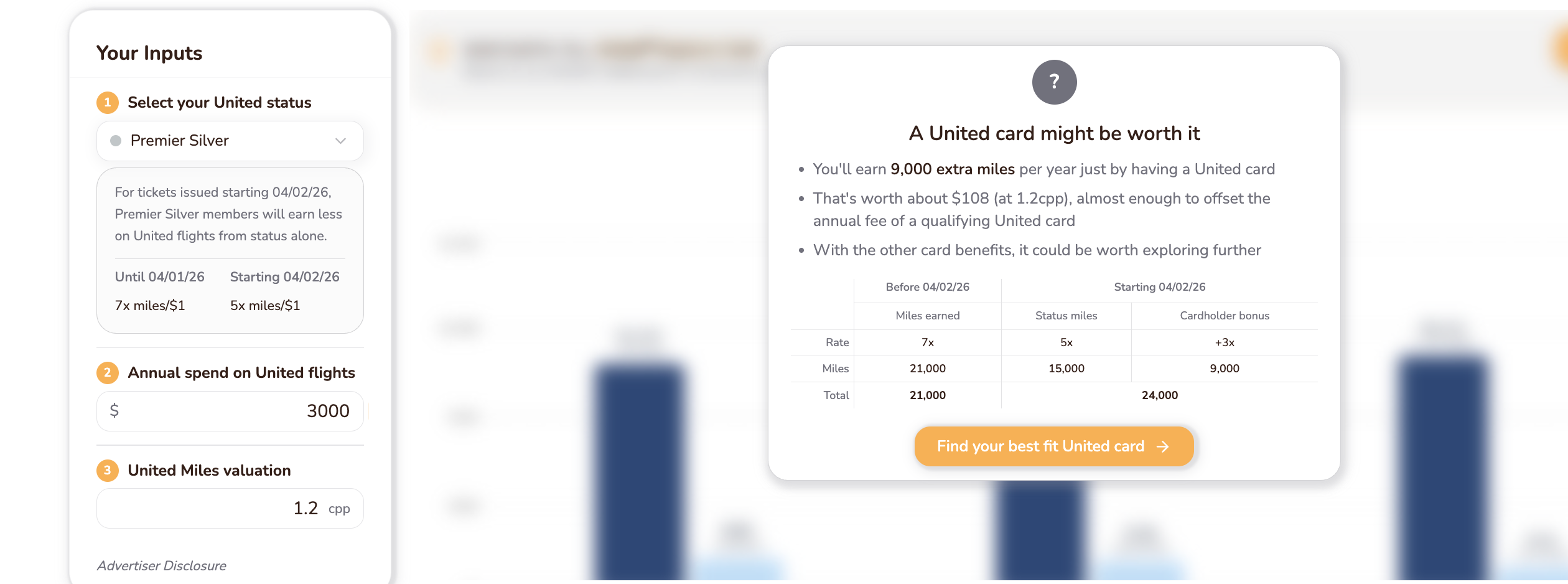
First, enter your inputs in on the left hand side (select your status, annual spend, and how much you value United miles)
Then, click calculate to see if the calculator thinks you should continue (it will either tell you No, Maybe, or Yes)
Finally, adjust your inputs per card to determine which one is the best value for you
Our United Calculator does two things: it first calculates how many additional miles you'd earn from these changes and then converts than into a yearly valuation.
The first bar for each card corresponds to the "Y1 First Year Value" of the card, which values the welcome bonus of the card alongside all the added benefits you get from the cards. The second bar for each card corresponds to the "Y2 Second Year Value" of the card, which tells you about the ongoing value you'd get from the card.
With your spending inputs, the calculator can first determine just how many additional miles you'd get from the various United changes. Then, you have the freedom to adjust how much you value the various perks on the United cards (these aren't changing):
Rideshare credit
Global Entry/TSA PreCheck/NEXUS Credit
JSX Credit
Avis/Budget Credit
For instance, the majority of people would actually value the JSX Credit at $0 since it's not likely to be used. Likewise, we find the Avis/Budget credits to be overly restricting, so we also don't value that super highly. However, the Quest's annual travel credit (which is just United TravelBank credit) is likely to be very highly valued by frequent United flyers.
The United Calculator is designed to give you a painless view into what the math says is the best option for you. The best card is also highlighted in orange and has a ribbon next to it. We determine that based on the overall value the card provides.
United miles don't have one fixed value, but we take a conservative estimate of 1.2 cents per mile. That said, the United Calculator allows you to fully adjust the valuation of United miles however you please.
For instance, if you value United miles highly, you can adjust accordingly. The higher you value United miles, the more likely the United cards are a relevant addition to your wallet.
The right answer depends almost entirely on how much you spend on United flights. Here's a rough proxy you can use to determine if you should get a United card:
Do you have United status? If yes, you should probably get a United card. You or your company probably spent a lot of money on United flights, so you're set to earn a lot more miles with the United cardholder bonus
If you don't have United status, do you value checked bags highly on United? If yes, you probably would benefit from getting the United℠ Explorer Card (the lowest costing United card with immediate checked bag benefits that also lets you earn additional points)
If you don't have status & don't care about checked bags, do you spend more than $3,000 per year on United flights? If yes, you probably want to think about getting a United card
Here are some United cards that qualify for the credit worth knowing about:
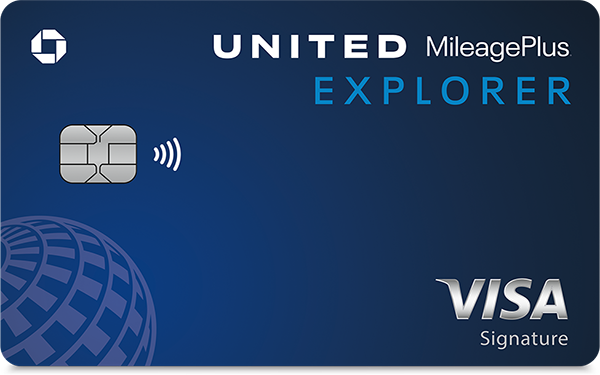
United℠ Explorer Card: $150 annual fee (waived for the first year). You get a free checked bag, two one-time United Club passes annually, and expanded saver award availability.
United Quest℠ Card: $350 annual fee with $200 in annual United travel credits, a 10,000-mile award discount each year you hold the card, and stronger earning rates on United purchases.
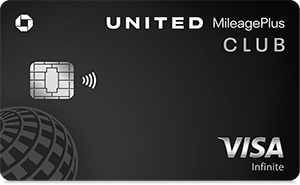
United Club℠ Card: $695 annual fee that also comes with United Club lounge access
Several other cards, including some of the business cards and legacy United cards qualify. Check here for the full list of cards that get you the increased cardholder earn rate.
Not sure which card makes sense for you? Run your numbers through the nextcard United Miles Calculator and get a clear answer based on your actual situation.
Both these cards do not carry any annual fee, while still allowing you to earn United miles on your spend.
However, you would need to spend $10,000 in a calendar year in order to earn the increased cardholder rate and unlock the 10% cardholder award discount. I don't think is worth doing for most people. You're probably better off getting one of the paid United cards.
Non-cardholders now earn as few as 3 miles per dollar on standard United flights (half of what cardholders earn at the same status level). If you fly United even a few times a year, that gap adds up fast, and a co-branded card can pay for itself before you've earned a single bonus mile.
The honest answer is that it depends on how you fly and spend. If you book award travel regularly, award discounts and travel credits can offset annual fees quickly. And if you're chasing premium cabin redemptions, the earning boost and expanded saver availability that come with a co-branded card can mean the difference between finding the seat you want or missing it entirely.
Run the numbers for your own situation before deciding. The United miles calculator factors in your flying spend, annual fee, welcome bonus, and card perks to show you exactly which card puts more value in your pocket.
The calculator takes your estimated annual spend on United flights, your MileagePlus status, and how much you value United miles, then calculates the total first-year and ongoing value of each card. It factors in the welcome bonus, annual fee, the April 2026 cardholder earning boost, and each card's perks so you can see which card puts the most value back in your pocket.
All the United cards with annual fees include at least a free first checked bag for the primary cardholder and a companion on the same reservation. Since United charges for bags on most fares, this perk alone can offset a meaningful portion of the annual fee if you check a bag even a few times a year.
Saver awards are the lower-cost tier with limited availability that United controls. Standard awards cost roughly double the miles but are available on more flights. The catch: you're paying twice as many miles for the same seat.
Qualifying cardholders get expanded access to Polaris saver award availability, which makes the need to get a United card all that much more important.
We use a conservative estimate of 1.2 cents per mile, though the actual value depends entirely on how you redeem them. Saver award bookings on long-haul international routes (especially in business class) can push value well above 2 cents per mile, while cash-equivalent redemptions typically fall below 1 cent. The United Miles Calculator lets you adjust this valuation to match your own travel style.
Yes, but United co-branded cardholders see expanded saver award availability that non-cardholders can't access. If you fly United even occasionally, a card like the United℠ Explorer Card can unlock more saver seats and save you miles on every award booking with at least a 10% discount.
Advertiser Disclosure: nextcard may receive compensation from card issuers. Opinions expressed here are the author's alone, not those of any bank, credit card issuer, airlines or hotel chain. For the most up-to-date terms & conditions, refer to the official credit card application on the issuer's website.
With United's major MileagePlus earnings overhaul announced today April 02, you might be wondering whether a United co-branded card is worth getting (or keeping).
Long story short, if you don't have a card, you're going to take a steep hit to how many miles you earn on United flights & pay more for your award flight redemptions.
The nextcard United Miles Calculator breaks it all down for you based on how you actually spend on United flights.
TLDR:
United's April 2026 changes cut earning rates for non-cardholders by up to 40%, making the case for a co-branded card much stronger.
United co-branded cardholders get up to 15% off award flights and see more saver availability than non-cardholders.
The nextcard United Miles Calculator shows you which United card would be the best fit for you, using your estimated spending.
The earning gap between cardholders and non-cardholders is now pretty significant at every status level.
A no-status member without a card earns just 3 miles per dollar on United flights. Add a co-branded card and that doubles to 6 miles per dollar. For top-tier Premier 1K members, the difference is 9 miles per dollar without a card versus 12 with one.
It's important to note that basic economy fares now earn zero United miles for non-card holders without status.
Status Level | Non-Cardholder | Cardholder |
|---|---|---|
Member | 3 miles/dollar | 6 miles/dollar |
Silver | 5 miles/dollar | 8 miles/dollar |
Gold | 6 miles/dollar | 9 miles/dollar |
Platinum | 7 miles/dollar | 10 miles/dollar |
Premier 1K | 9 miles/dollar | 12 miles/dollar |
Additionally, United co-branded cardholders get at least 10% discount on award flights, with Premier members saving up to 15%. Cardholders also unlock expanded Polaris Saver Award availability, meaning you'll see more saver-priced seats that aren't visible to non-cardholders. This can be particularly valuable, especially when it comes to maximizing the value of your United miles.
Confused by all of these changes?
The nextcard United Miles Calculator helps you quickly figure out if you should get a United card and which United card to get given all of these changes.
First, enter your inputs in on the left hand side (select your status, annual spend, and how much you value United miles)
Then, click calculate to see if the calculator thinks you should continue (it will either tell you No, Maybe, or Yes)
Finally, adjust your inputs per card to determine which one is the best value for you
Our United Calculator does two things: it first calculates how many additional miles you'd earn from these changes and then converts than into a yearly valuation.
The first bar for each card corresponds to the "Y1 First Year Value" of the card, which values the welcome bonus of the card alongside all the added benefits you get from the cards. The second bar for each card corresponds to the "Y2 Second Year Value" of the card, which tells you about the ongoing value you'd get from the card.
With your spending inputs, the calculator can first determine just how many additional miles you'd get from the various United changes. Then, you have the freedom to adjust how much you value the various perks on the United cards (these aren't changing):
Rideshare credit
Global Entry/TSA PreCheck/NEXUS Credit
JSX Credit
Avis/Budget Credit
For instance, the majority of people would actually value the JSX Credit at $0 since it's not likely to be used. Likewise, we find the Avis/Budget credits to be overly restricting, so we also don't value that super highly. However, the Quest's annual travel credit (which is just United TravelBank credit) is likely to be very highly valued by frequent United flyers.
The United Calculator is designed to give you a painless view into what the math says is the best option for you. The best card is also highlighted in orange and has a ribbon next to it. We determine that based on the overall value the card provides.
United miles don't have one fixed value, but we take a conservative estimate of 1.2 cents per mile. That said, the United Calculator allows you to fully adjust the valuation of United miles however you please.
For instance, if you value United miles highly, you can adjust accordingly. The higher you value United miles, the more likely the United cards are a relevant addition to your wallet.
The right answer depends almost entirely on how much you spend on United flights. Here's a rough proxy you can use to determine if you should get a United card:
Do you have United status? If yes, you should probably get a United card. You or your company probably spent a lot of money on United flights, so you're set to earn a lot more miles with the United cardholder bonus
If you don't have United status, do you value checked bags highly on United? If yes, you probably would benefit from getting the United℠ Explorer Card (the lowest costing United card with immediate checked bag benefits that also lets you earn additional points)
If you don't have status & don't care about checked bags, do you spend more than $3,000 per year on United flights? If yes, you probably want to think about getting a United card
Here are some United cards that qualify for the credit worth knowing about:
United℠ Explorer Card: $150 annual fee (waived for the first year). You get a free checked bag, two one-time United Club passes annually, and expanded saver award availability.
United Quest℠ Card: $350 annual fee with $200 in annual United travel credits, a 10,000-mile award discount each year you hold the card, and stronger earning rates on United purchases.
United Club℠ Card: $695 annual fee that also comes with United Club lounge access
Several other cards, including some of the business cards and legacy United cards qualify. Check here for the full list of cards that get you the increased cardholder earn rate.
Not sure which card makes sense for you? Run your numbers through the nextcard United Miles Calculator and get a clear answer based on your actual situation.
Both these cards do not carry any annual fee, while still allowing you to earn United miles on your spend.
However, you would need to spend $10,000 in a calendar year in order to earn the increased cardholder rate and unlock the 10% cardholder award discount. I don't think is worth doing for most people. You're probably better off getting one of the paid United cards.
Non-cardholders now earn as few as 3 miles per dollar on standard United flights (half of what cardholders earn at the same status level). If you fly United even a few times a year, that gap adds up fast, and a co-branded card can pay for itself before you've earned a single bonus mile.
The honest answer is that it depends on how you fly and spend. If you book award travel regularly, award discounts and travel credits can offset annual fees quickly. And if you're chasing premium cabin redemptions, the earning boost and expanded saver availability that come with a co-branded card can mean the difference between finding the seat you want or missing it entirely.
Run the numbers for your own situation before deciding. The United miles calculator factors in your flying spend, annual fee, welcome bonus, and card perks to show you exactly which card puts more value in your pocket.
The calculator takes your estimated annual spend on United flights, your MileagePlus status, and how much you value United miles, then calculates the total first-year and ongoing value of each card. It factors in the welcome bonus, annual fee, the April 2026 cardholder earning boost, and each card's perks so you can see which card puts the most value back in your pocket.
All the United cards with annual fees include at least a free first checked bag for the primary cardholder and a companion on the same reservation. Since United charges for bags on most fares, this perk alone can offset a meaningful portion of the annual fee if you check a bag even a few times a year.
Saver awards are the lower-cost tier with limited availability that United controls. Standard awards cost roughly double the miles but are available on more flights. The catch: you're paying twice as many miles for the same seat.
Qualifying cardholders get expanded access to Polaris saver award availability, which makes the need to get a United card all that much more important.
We use a conservative estimate of 1.2 cents per mile, though the actual value depends entirely on how you redeem them. Saver award bookings on long-haul international routes (especially in business class) can push value well above 2 cents per mile, while cash-equivalent redemptions typically fall below 1 cent. The United Miles Calculator lets you adjust this valuation to match your own travel style.
Yes, but United co-branded cardholders see expanded saver award availability that non-cardholders can't access. If you fly United even occasionally, a card like the United℠ Explorer Card can unlock more saver seats and save you miles on every award booking with at least a 10% discount.
See how many MileagePlus miles you'd earn with a United credit card. Compare Explorer, Quest, and Club side-by-side to find the best card for your flying habits.
Interactive tool
Open tool