

Atmos Summit Card Review: Is a $395 Annual Fee Worth It in 2026?
NCnextcard team

Advertiser Disclosure: nextcard may receive compensation from card issuers. Opinions expressed here are the author's alone, not those of any bank, credit card issuer, airlines or hotel chain. For the most up-to-date terms & conditions, refer to the official credit card application on the issuer's website.
If you're carrying 2 to 4 credit cards and already feeling like you can't keep up with all your benefits, you're not alone — and you're not doing anything wrong. Take the Amex Platinum: it runs a $895 annual fee and comes loaded with over a dozen credits like the entertainment, Resy dining, airline incidentals, and Fine Hotels + Resorts® credits.
Some reset monthly, some follow the calendar year, some are semiannual, and several require enrollment before they'll even trigger.
Miss one month, and that value is just gone. A real credit card benefit optimization tool solves this by pulling everything into one view, sending reminders tied to actual reset windows, and showing you exactly which benefits you're leaving on the table before they disappear for good.
TLDR:
Statement credits are typically use it or lose
Static spreadsheets that require manual updates are good in the short run, but are hard to maintain because they are not automated
One way to keep track of your cards is by looking at total redeemable credits minus annual fees, and this math determines if premium cards are worth keeping.
nextcard wallet is your credit card assistant: track credits, auto-add offers, and never miss value across every card in your wallet, all from one dashboard.
Over the past decade, card issuers have been stacking more and more credits onto their products. A card that once charged a flat annual fee now comes bundled with dining credits, travel credits, hotel perks, entertainment subscriptions, and lounge access. Each credit carries its own reset schedule, enrollment requirements, and list of eligible merchants.
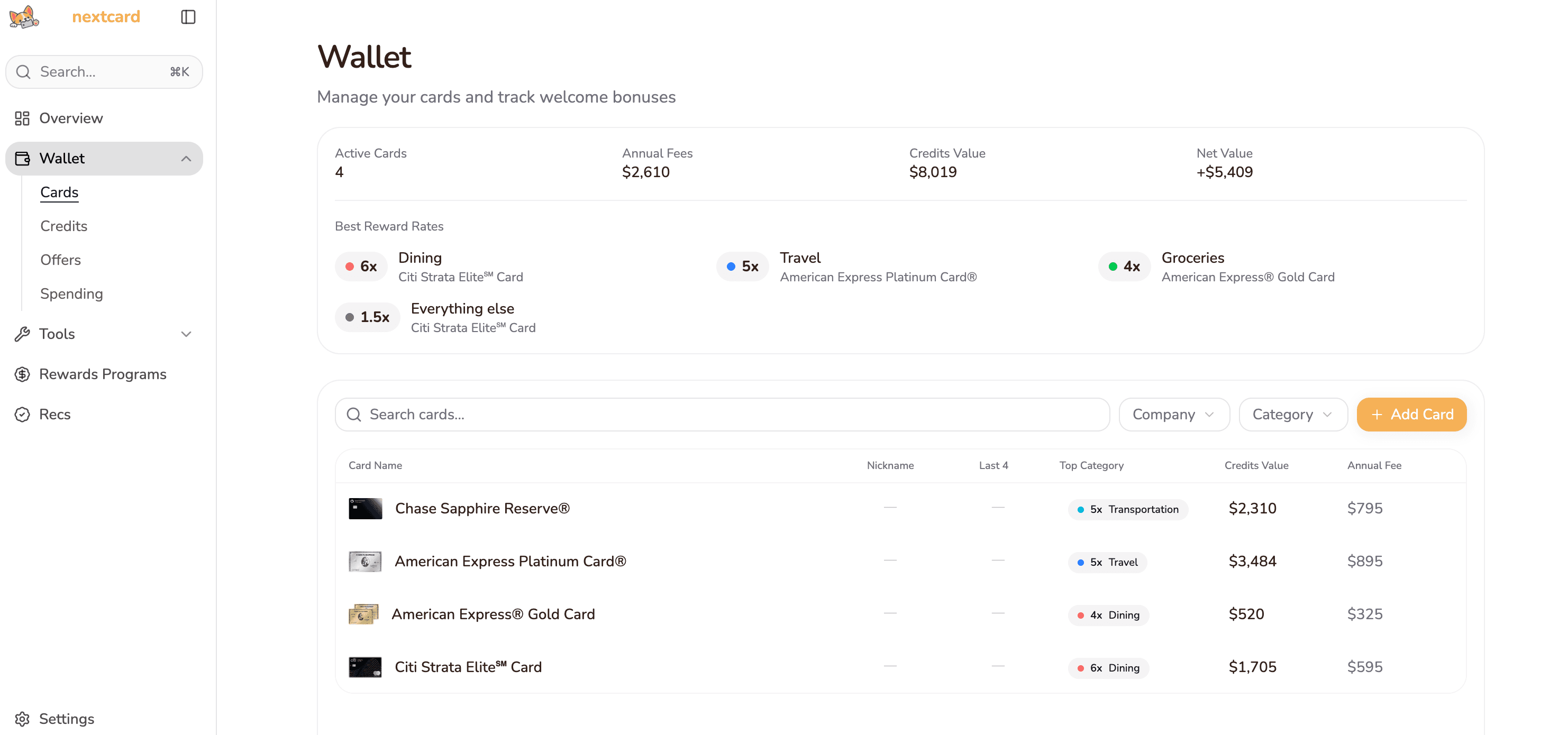
For example, take the Chase Sapphire Reserve®. Prior to its major changes in 2025, it only had a handful of credits. Now, it has ~10 credits to keep track of, all with their own timing schedules (monthly Lyft credit, semiannual Stubhub credit, etc)
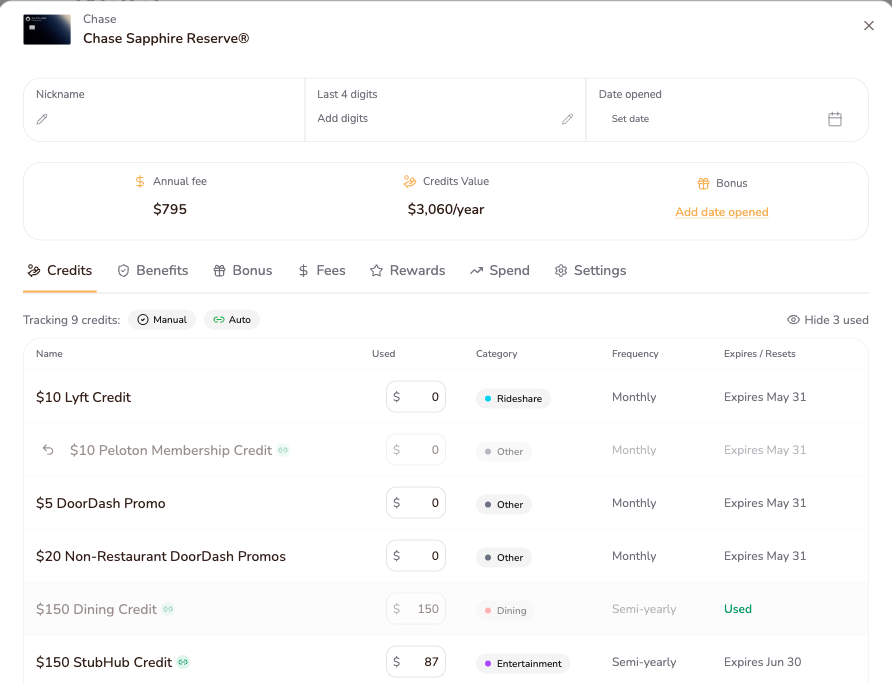
The more credits a card adds, the easier it becomes to miss one... and every extra layer of complexity is another chance for value to quietly disappear. Finding a card loaded with perks is the easy part. Keeping up with all of them before the benefit window closes is where most people fall short.
Statement credits are automatic reductions applied to your balance after a qualifying purchase. You spend at an eligible merchant, the issuer detects it, and the credit posts within a few days. No coupon, no code, just a line item on your statement.
The tricky part is the reset schedule. Some credits follow a calendar year (January to December), while others follow a cardmember year tied to account opening. Miss the distinction, and you might think you have months left when the credit actually resets in weeks. This is partly by design; issuers count on a percentage of credits going unused, a concept known as breakage, where unredeemed value flows back to the issuer rather than to you.
There are a few other things worth knowing here:
Some credits require you to enroll beforehand. No enrollment, no credit.
Monthly credits are the easiest to lose. A $10 dining credit sounds simple until you realize it doesn't roll over
Credit Type | Annual Value (Up to) | Reset Schedule | Enrollment Required | Key Redemption Details |
|---|---|---|---|---|
Chase Sapphire Reserve® Dining Credit | $300 | Up to $150 semiannually | No | Automatically applies to dining purchases made at Sapphire Reserve Exclusive Table Restaurants |
American Express Platinum Card® Resy Credit | $400 | Up to $100 every quarter | Yes | Applies to eligible US Resy dining purchases |
Capital One Venture X Travel Credit | $300 | Cardmember year | No | Applies to Capital One Travel portal bookings. Must book through their portal to trigger credit, limiting flexibility compared to Chase. |
For years, the go-to solution for tracking credits was a spreadsheet. It works well... until you have more than 2-3 cards to manage, and suddenly you're manually updating rows, cross-checking reset dates, and still missing credits because you forgot to log in and check.
nextcard takes a different approach. It connects to your cards through Plaid, pulls in your transaction data automatically, and identifies which credits you've already used without you having to enter a thing.
A few things that make the automated approach worth switching to:
Transaction data feeds in automatically & safely through Plaid, so your credit usage updates without you doing anything
We don't sell your data & all info is encrypted
Timely reminders go out before credits expire or reset, tied to the specific card and window, not a generic nudge
Your full portfolio, total annual fees, and net credit value are visible in one place at all times
Monthly, quarterly, and annual reset schedules are all tracked separately so nothing gets lumped together incorrectly
A few tools exist specifically for tracking credit card benefits, and they all take different approaches. Understanding the tradeoffs makes it easier to see where automated tracking actually wins.
CardPointers is one of the better-known benefit trackers, but it works on a manual check-off model. You open the app, mark a credit as used, and hope you remembered to do it. There's no transaction data feeding in automatically, so keeping it current requires consistent effort on your end. For people with a card or two, that might be fine. Once you're managing five or more cards with dozens of reset windows, the manual upkeep becomes its own problem.
(btw, CardPointers charges you if you want to track more than one of each type of card; nextcard lets you track an unlimited number of cards manually)
MaxRewards connects to your accounts and pulls in transaction data, which sounds similar to nextcard wallet on the surface.
The difference is how it accesses that data: MaxRewards stores your card login credentials directly. That's a meaningful security tradeoff since your usernames and passwords sitting in a third-party database. That's incredibly suspicious and there have been reports of people getting banned from their bank accounts because of this.
nextcard wallet connects through Plaid, which means your actual login credentials stay with your bank, not with us.
Transaction data flows in automatically, credits get tracked without manual input, and reminders go out before reset windows close. The goal is to remove the maintenance entirely, not just make it slightly easier. We can also calculate your credits values from the last 2 years, which paints a highly detailed picture of your credit usage versus your annual fees.
Some benefits only activate at specific locations. Dining credits, hotel collections, lounge access, restaurant rewards programs...these perks require you to know exactly which merchants qualify before you show up.
nextcard's suite of maps and tools tackles this directly. The MealMaxxer shows you where restaurants that are part of Amex's Resy or Chase's Exclusive Table Restaurants are. The HotelMaxxer helps you see all the Amex FHR, Chase Edit, United Renowned Hotels, and Bilt Home Away From Home properties on one map.
Annual fees aren't inherently bad. They're a trade-off, and whether that trade-off makes sense depends entirely on what you actually use. The problem is most people have no easy way to know, especially across all their cards.
That's where nextcard wallet comes in. Because nextcard is already tracking every credit you use across your cards automatically, it can calculate how much value you're actually pulling from each card and stack that against what you're paying in annual fees. No manual tallying, no spreadsheet math... just a clear picture of where you stand.
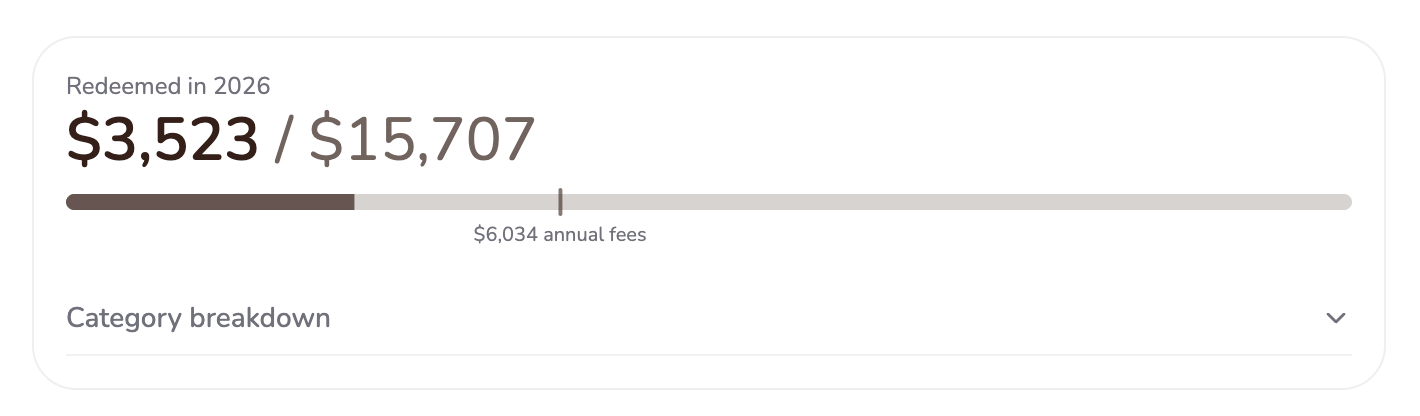
Your nextcard wallet dashboard shows your total annual fees across your full portfolio alongside the net value of your redeemable credits. If you're consistently redeeming dining, travel, and other credits, that number tells a very different story than the sticker price of your annual fee. If you're barely using anything, the gap is hard to ignore.
The expiring credits, the annual fee math, the multi-card tracking problem... nextcard is built to solve all of it in one place.
nextcard wallet tracks every credit you use and stacks that against your annual fees, so you always know whether the cards you carry are actually paying off. nextcard notifs sends alerts before benefits expire or reset, tied to specific cards and windows. The maps and calculators handle the location-specific and numbers-heavy research so you don't have to.
You're already paying for these benefits, so maximizing card benefits is really just about making sure they don't go to waste. The cards in your wallet right now could be worth hundreds more per year if you knew which credits were about to reset and which perks you forgot to activate.
By the way: nextcard will always be free, forever; but if you want expanded access to automated features, that's where our Pro plan comes in with automation and other fun tools.
Card issuers add credits to justify rising annual fees and stay competitive. Each new credit is a reason to keep the card, but the result is that cardholders now have to track a growing number of reset windows, enrollment requirements, and eligible merchants just to break even on what they're paying.
nextcard safely connects to your cards through Plaid, which pulls in your transaction data without ever storing your login credentials. From there, nextcard matches your transactions against each card's credit structure and updates your usage automatically, so you always know what's been redeemed and what's still on the table.
Because nextcard tracks every credit you redeem across your full card portfolio, it can stack your total annual fees against the net value of credits you've actually used. If you're consistently redeeming dining, travel, and other credits, that number tells a very different story than the sticker price of your annual fee.
Calendar year credits reset every January 1st regardless of when you opened your card, while cardmember year credits reset based on your account anniversary date. If you're not tracking both schedules separately, it's easy to assume you have more time than you actually do.
This is mostly by design. Issuers count on a percentage of credits going unused, a concept known as breakage, where unredeemed value flows back to the issuer. Hard reset windows tied to specific time periods and merchants push you to spend in certain ways, and any value you don't claim before the window closes is gone.
Advertiser Disclosure: nextcard may receive compensation from card issuers. Opinions expressed here are the author's alone, not those of any bank, credit card issuer, airlines or hotel chain. For the most up-to-date terms & conditions, refer to the official credit card application on the issuer's website.
If you're carrying 2 to 4 credit cards and already feeling like you can't keep up with all your benefits, you're not alone — and you're not doing anything wrong. Take the Amex Platinum: it runs a $895 annual fee and comes loaded with over a dozen credits like the entertainment, Resy dining, airline incidentals, and Fine Hotels + Resorts® credits.
Some reset monthly, some follow the calendar year, some are semiannual, and several require enrollment before they'll even trigger.
Miss one month, and that value is just gone. A real credit card benefit optimization tool solves this by pulling everything into one view, sending reminders tied to actual reset windows, and showing you exactly which benefits you're leaving on the table before they disappear for good.
TLDR:
Statement credits are typically use it or lose
Static spreadsheets that require manual updates are good in the short run, but are hard to maintain because they are not automated
One way to keep track of your cards is by looking at total redeemable credits minus annual fees, and this math determines if premium cards are worth keeping.
nextcard wallet is your credit card assistant: track credits, auto-add offers, and never miss value across every card in your wallet, all from one dashboard.
Over the past decade, card issuers have been stacking more and more credits onto their products. A card that once charged a flat annual fee now comes bundled with dining credits, travel credits, hotel perks, entertainment subscriptions, and lounge access. Each credit carries its own reset schedule, enrollment requirements, and list of eligible merchants.
For example, take the Chase Sapphire Reserve®. Prior to its major changes in 2025, it only had a handful of credits. Now, it has ~10 credits to keep track of, all with their own timing schedules (monthly Lyft credit, semiannual Stubhub credit, etc)
The more credits a card adds, the easier it becomes to miss one... and every extra layer of complexity is another chance for value to quietly disappear. Finding a card loaded with perks is the easy part. Keeping up with all of them before the benefit window closes is where most people fall short.
Statement credits are automatic reductions applied to your balance after a qualifying purchase. You spend at an eligible merchant, the issuer detects it, and the credit posts within a few days. No coupon, no code, just a line item on your statement.
The tricky part is the reset schedule. Some credits follow a calendar year (January to December), while others follow a cardmember year tied to account opening. Miss the distinction, and you might think you have months left when the credit actually resets in weeks. This is partly by design; issuers count on a percentage of credits going unused, a concept known as breakage, where unredeemed value flows back to the issuer rather than to you.
There are a few other things worth knowing here:
Some credits require you to enroll beforehand. No enrollment, no credit.
Monthly credits are the easiest to lose. A $10 dining credit sounds simple until you realize it doesn't roll over
Credit Type | Annual Value (Up to) | Reset Schedule | Enrollment Required | Key Redemption Details |
|---|---|---|---|---|
For years, the go-to solution for tracking credits was a spreadsheet. It works well... until you have more than 2-3 cards to manage, and suddenly you're manually updating rows, cross-checking reset dates, and still missing credits because you forgot to log in and check.
nextcard takes a different approach. It connects to your cards through Plaid, pulls in your transaction data automatically, and identifies which credits you've already used without you having to enter a thing.
A few things that make the automated approach worth switching to:
Transaction data feeds in automatically & safely through Plaid, so your credit usage updates without you doing anything
We don't sell your data & all info is encrypted
Timely reminders go out before credits expire or reset, tied to the specific card and window, not a generic nudge
Your full portfolio, total annual fees, and net credit value are visible in one place at all times
Monthly, quarterly, and annual reset schedules are all tracked separately so nothing gets lumped together incorrectly
A few tools exist specifically for tracking credit card benefits, and they all take different approaches. Understanding the tradeoffs makes it easier to see where automated tracking actually wins.
CardPointers is one of the better-known benefit trackers, but it works on a manual check-off model. You open the app, mark a credit as used, and hope you remembered to do it. There's no transaction data feeding in automatically, so keeping it current requires consistent effort on your end. For people with a card or two, that might be fine. Once you're managing five or more cards with dozens of reset windows, the manual upkeep becomes its own problem.
(btw, CardPointers charges you if you want to track more than one of each type of card; nextcard lets you track an unlimited number of cards manually)
MaxRewards connects to your accounts and pulls in transaction data, which sounds similar to nextcard wallet on the surface.
The difference is how it accesses that data: MaxRewards stores your card login credentials directly. That's a meaningful security tradeoff since your usernames and passwords sitting in a third-party database. That's incredibly suspicious and there have been reports of people getting banned from their bank accounts because of this.
nextcard wallet connects through Plaid, which means your actual login credentials stay with your bank, not with us.
Transaction data flows in automatically, credits get tracked without manual input, and reminders go out before reset windows close. The goal is to remove the maintenance entirely, not just make it slightly easier. We can also calculate your credits values from the last 2 years, which paints a highly detailed picture of your credit usage versus your annual fees.
Some benefits only activate at specific locations. Dining credits, hotel collections, lounge access, restaurant rewards programs...these perks require you to know exactly which merchants qualify before you show up.
nextcard's suite of maps and tools tackles this directly. The MealMaxxer shows you where restaurants that are part of Amex's Resy or Chase's Exclusive Table Restaurants are. The HotelMaxxer helps you see all the Amex FHR, Chase Edit, United Renowned Hotels, and Bilt Home Away From Home properties on one map.
Annual fees aren't inherently bad. They're a trade-off, and whether that trade-off makes sense depends entirely on what you actually use. The problem is most people have no easy way to know, especially across all their cards.
That's where nextcard wallet comes in. Because nextcard is already tracking every credit you use across your cards automatically, it can calculate how much value you're actually pulling from each card and stack that against what you're paying in annual fees. No manual tallying, no spreadsheet math... just a clear picture of where you stand.
Your nextcard wallet dashboard shows your total annual fees across your full portfolio alongside the net value of your redeemable credits. If you're consistently redeeming dining, travel, and other credits, that number tells a very different story than the sticker price of your annual fee. If you're barely using anything, the gap is hard to ignore.
The expiring credits, the annual fee math, the multi-card tracking problem... nextcard is built to solve all of it in one place.
nextcard wallet tracks every credit you use and stacks that against your annual fees, so you always know whether the cards you carry are actually paying off. nextcard notifs sends alerts before benefits expire or reset, tied to specific cards and windows. The maps and calculators handle the location-specific and numbers-heavy research so you don't have to.
You're already paying for these benefits, so maximizing card benefits is really just about making sure they don't go to waste. The cards in your wallet right now could be worth hundreds more per year if you knew which credits were about to reset and which perks you forgot to activate.
By the way: nextcard will always be free, forever; but if you want expanded access to automated features, that's where our Pro plan comes in with automation and other fun tools.
Card issuers add credits to justify rising annual fees and stay competitive. Each new credit is a reason to keep the card, but the result is that cardholders now have to track a growing number of reset windows, enrollment requirements, and eligible merchants just to break even on what they're paying.
nextcard safely connects to your cards through Plaid, which pulls in your transaction data without ever storing your login credentials. From there, nextcard matches your transactions against each card's credit structure and updates your usage automatically, so you always know what's been redeemed and what's still on the table.
Because nextcard tracks every credit you redeem across your full card portfolio, it can stack your total annual fees against the net value of credits you've actually used. If you're consistently redeeming dining, travel, and other credits, that number tells a very different story than the sticker price of your annual fee.
Calendar year credits reset every January 1st regardless of when you opened your card, while cardmember year credits reset based on your account anniversary date. If you're not tracking both schedules separately, it's easy to assume you have more time than you actually do.
This is mostly by design. Issuers count on a percentage of credits going unused, a concept known as breakage, where unredeemed value flows back to the issuer. Hard reset windows tied to specific time periods and merchants push you to spend in certain ways, and any value you don't claim before the window closes is gone.
Chase Sapphire Reserve® Dining Credit
$300 |
Up to $150 semiannually |
No |
Automatically applies to dining purchases made at Sapphire Reserve Exclusive Table Restaurants |
American Express Platinum Card® Resy Credit | $400 | Up to $100 every quarter | Yes | Applies to eligible US Resy dining purchases |
Capital One Venture X Travel Credit | $300 | Cardmember year | No | Applies to Capital One Travel portal bookings. Must book through their portal to trigger credit, limiting flexibility compared to Chase. |