


How can I keep track of my credit card benefits in 2026?
NCnextcard team

Advertiser Disclosure: nextcard may receive compensation from card issuers. Opinions expressed here are the author's alone, not those of any bank, credit card issuer, airlines or hotel chain. For the most up-to-date terms & conditions, refer to the official credit card application on the issuer's website.
MaxRewards is a credit card rewards management app that helps users track their cards, rewards balances, benefits, bills, and spending in one place. The app connects to credit card accounts and can help users identify the best card to use for purchases, monitor premium card credits, and automatically activate merchant offers or bonus categories.
Despite its good intentions, MaxRewards has a history of security issues and requires you to fork over your banking login credentials. While it positions itself as a tool for simplifying credit card management, that's a huge tradeoff and risk to stomach.
This review looks into understanding what it is and if it's worth using in 2026.
TL;DR:
MaxRewards Gold costs $108/year and auto-activates card offers + tracks your credit card benefits, but syncing breaks often
The app stores your bank credentials directly, which can trigger fraud locks at Chase
nextcard's free tier covers unlimited credit tracking, email and text reminders, personalized card recs, and basic tools... all at no cost
nextcard Pro adds safe automated credit tracking via Plaid, so your benefits are identified without manual entry and without your login credentials ever touching our servers
MaxRewards is a mobile app that consolidates your credit cards into one dashboard so you can track rewards, activate offers, and monitor spending across issuers. You connect your card accounts through the app, and it pulls in available offers, points balances, and credits usage.
The core idea is automatic offer activation. Instead of logging into Amex Offers, Chase Offers, and Citi Merchant Offers one by one, MaxRewards bundles them together and activates eligible deals on your behalf (a feature reserved for the paid Gold tier).
MaxRewards also automatically tracks the majority of your credit card credits, such as your Chase Sapphire Reserve® dining credit.
MaxRewards works with the major US card issuers, including:
American Express
Chase
Capital One
Citi
Bank of America
Wells Fargo
Discover
MaxRewards runs on a three-tier model, and the gap between Free and Gold is where most of the actual value sits.
Tier | Starting Price | What You Get |
|---|---|---|
Free | $0 | Basic card tracking, manual offer viewing, points dashboard |
Gold | $9/month (billed $108/year, pay-what-you-want) | Auto-activation of offers, credit tracking, quarterly bonus category activation, "best card to use" prompts, benefits consolidation, bonus trackers |
Platinum | $20/month (billed $240/year, pay-what-you-want) | Spend profiles, business expense categories, and receipt management on top of Gold |
If you only want to peek at your cards in one place, Free works fine. The auto-activation magic (the reason most people sign up) lives behind Gold. Platinum targets freelancers and small business owners who need expense tooling layered on.
Credit where it's due: MaxRewards earns its fans for good reasons. Gold members pull in an average of $662 from merchant offers in their first year, mostly because the app activates eligible deals across Amex, Chase, Citi, and Bank of America without you lifting a finger.
A few features stand out:
Auto-activation of rotating 5% categories on Chase Freedom and Discover it cards each quarter, so you never miss a bonus window
One-tap merchant offer enrollment across every linked issuer, which saves the tedious clicking through Amex Offers and Chase Offers manually
Centralized automated tools to track points balances and credits in one feed
The value scales with your wallet. If you carry four or more cards from different issuers, the time saved on offer hunting tends to justify Gold for active users.
For all its strengths, MaxRewards has a reputation problem when it comes to staying safely connected.
Chase and Amex accounts tend to unsync most often, pushing users to re-authenticate with 2FA codes two to four times a month. That ritual gets old fast, especially if you carry five or more cards.
The tracking accuracy can also slip:
Statement credits sometimes show as unused even after you've already redeemed them
Welcome bonus progress trackers occasionally pull incorrect spending totals
Card details like earn rates, annual fees, and benefit values are sometimes outdated or simply wrong
None of this is a dealbreaker on its own, but the upkeep adds friction to a tool that's supposed to remove it.
Security is the part of the MaxRewards conversation that gets glossed over too often. To sync your accounts, the app asks for your bank username and password directly, and there is no opt-out for credential storage on their servers. That trade-off shows up in real reports from users:
Some Chase customers have had syncs trigger a fraud lock, leaving them locked out for days during review
Storing issuer credentials on a third-party server is a different risk profile than read-only API access
Aggressive logins from a new IP can trip fraud detection at Chase and Amex
I will never use MaxRewards because I don't want an unofficial third party vendor storing my sensitive banking login information. Even with good intentions, I’m uncomfortable giving a third-party app credentials tied to the same bank relationship where my checking account may also live

nextcard wallet uses Plaid for secure connections, so your login info never touches our servers & we are only given read access to transaction data.
The biggest problem with MaxRewards is security.
It's just not a great thing when your banking details are being stored by a third party vendor. The mere fact that people have had their accounts locked because of MaxRewards is scary.
That said, if you're willing to hand over your banking credentials, here's how MaxRewards is good/bad:
You hold 4+ cards across Amex, Chase, Citi, and Bank of America with frequent targeted offer activity
You want to automatically track your credit card benefit usage
You spend $400+ monthly at merchants that regularly run merchant-funded offers worth activating
You forget to activate quarterly bonus categories on Chase Freedom Flex® or Discover it® Cash Back
You don't want to give an unverified third party your banking information
You carry 2 to 3 cards and check offers occasionally on your own without much trouble
You'd rather not pay money for activating offers
Every pain point we covered above is exactly what we built nextcard to fix. Here's the side-by-side:
Read-only bank connections. We use Plaid for secure links, so your bank username and password never sit on our servers (or anyone else's). We have no idea what your bank login is... and that's how it should be
Low account ban risk. Because no aggressive logins are hitting Chase or Amex from our infrastructure, your accounts stay quiet and your relationships with issuers stay intact. Plaid is widely used for read-only financial data connections.
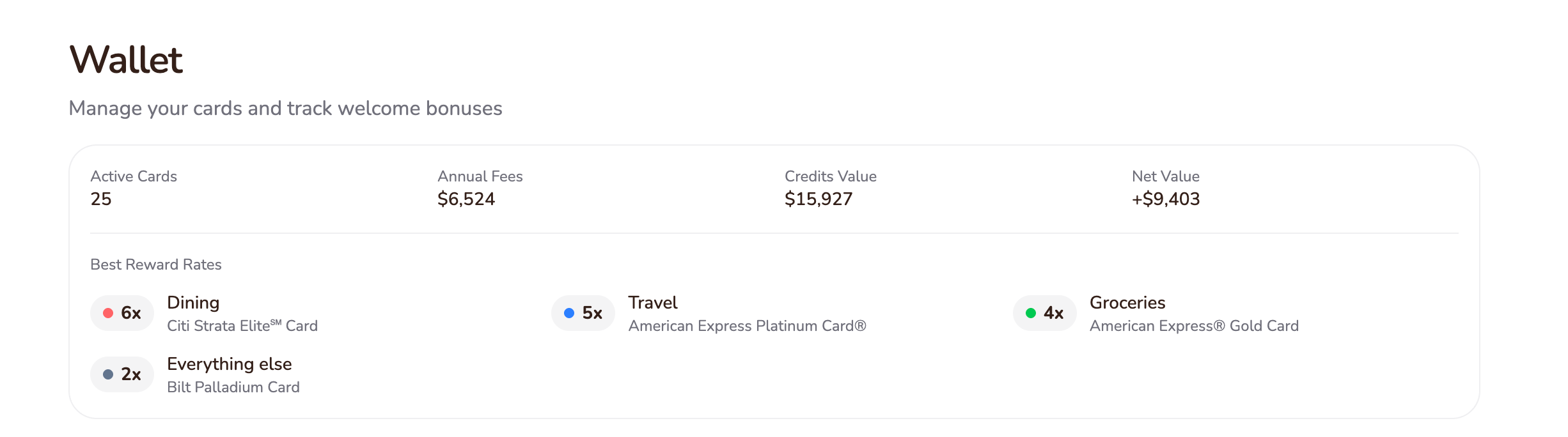
Centralized benefit tracking. nextcard wallet pulls your annual fees, statement credits, and net portfolio value into one clean dashboard for over 150 credit cards
Smart reminders. nextcard notifs pings you before credits expire, so you actually use the perks you're paying for.
Free to start, powerful when you upgrade. nextcard's free tier gives you unlimited credit tracking, email and text reminders, personalized card recs, and basic tools; no subscription required. nextcard Pro ($180/year) adds automated credit tracking, transaction overview, hotel price date search, priority map refresh, priority support, and early access to new tools (corgi approved).
MaxRewards is a useful tool if your main goal is automatic merchant offer activation & credit card benefit tracking, and for some rewards power users, MaxRewards Gold can justify its annual cost. But the product comes with a major trade-off in that its best features depend on a model that may require users to trust a third party with sensitive bank login credentials.
That is where nextcard is different. nextcard gives users the same core outcome MaxRewards promises: easier card tracking, benefit tracking, offer activation, reminders, and wallet optimization... but with a safer foundation. The free tier already covers manual credit tracking, reminders, personalized card recommendations, and basic tools, while nextcard Pro adds automated benefit tracking through Plaid, so bank login credentials never touch nextcard’s servers.
So the question is not just whether MaxRewards can help you earn more from your credit cards. It is whether you should accept the security and syncing trade-offs when a safer & more powerful alternative exists. For users who want the power of MaxRewards without the account-linking headaches, nextcard is the better place to start.
CardPointers takes a different approach to card tracking: you enter cards manually instead of linking bank credentials, which sidesteps the syncing headaches but loses the auto-activation magic.
CardPointers wins on breadth, MaxRewards wins on automation... but nextcard beats both options across the board. nextcard's free tier covers mostly everything that CardPointers+ charges $89.99/year for: unlimited manual credit tracking, offers activation, and wallet value.
If you want to go further, nextcard Pro adds fully automated benefit tracking powered by Plaid, so your credits are identified without manual entry and without your login credentials ever touching our servers. This incredibly powerful feature will even go up to two years back in time to find all your statement credits & help you paint a full picture of your value.
Either way, the nextcard UI is cleaner and more modern than CardPointers & MaxRewards at every tier.
MaxRewards is free for basic card tracking and manual offer viewing, but the core auto-activation + automated credit card tracking feature (the reason most people sign up) requires MaxRewards Gold at $108/year or MaxRewards Platinum at $240/year. Free users can see their points dashboard but miss out on automatic offer enrollment and best-card prompts.
Yes, MaxRewards syncing has triggered fraud locks for some Chase customers because the app stores your bank username and password and logs in repeatedly from third-party servers. Aggressive logins from new IPs can trip fraud detection at both Chase and Amex, leaving you locked out for days during review.
nextcard Pro uses Plaid for read-only bank connections, so your login credentials never sit on our servers and you avoid account ban risk entirely. We offer auto-activation of offers through our extension, centralized benefit tracking in nextcard wallet, and smart reminders via nextcard notifs for $180/year, without needing to worry about getting banned from Chase or Amex.
MaxRewards works with major US card issuers, including American Express, Bank of America, Barclays, Capital One, Chase, Citi, Discover, US Bank, and Wells Fargo. nextcard supports the same major issuers, but unlike MaxRewards, it never asks for your bank username or password: nextcard Pro connects via Plaid for read-only access, so your login credentials never touch our servers and your account isn't put at risk.
Advertiser Disclosure: nextcard may receive compensation from card issuers. Opinions expressed here are the author's alone, not those of any bank, credit card issuer, airlines or hotel chain. For the most up-to-date terms & conditions, refer to the official credit card application on the issuer's website.
MaxRewards is a credit card rewards management app that helps users track their cards, rewards balances, benefits, bills, and spending in one place. The app connects to credit card accounts and can help users identify the best card to use for purchases, monitor premium card credits, and automatically activate merchant offers or bonus categories.
Despite its good intentions, MaxRewards has a history of security issues and requires you to fork over your banking login credentials. While it positions itself as a tool for simplifying credit card management, that's a huge tradeoff and risk to stomach.
This review looks into understanding what it is and if it's worth using in 2026.
TL;DR:
MaxRewards Gold costs $108/year and auto-activates card offers + tracks your credit card benefits, but syncing breaks often
The app stores your bank credentials directly, which can trigger fraud locks at Chase
nextcard's free tier covers unlimited credit tracking, email and text reminders, personalized card recs, and basic tools... all at no cost
nextcard Pro adds safe automated credit tracking via Plaid, so your benefits are identified without manual entry and without your login credentials ever touching our servers
MaxRewards is a mobile app that consolidates your credit cards into one dashboard so you can track rewards, activate offers, and monitor spending across issuers. You connect your card accounts through the app, and it pulls in available offers, points balances, and credits usage.
The core idea is automatic offer activation. Instead of logging into Amex Offers, Chase Offers, and Citi Merchant Offers one by one, MaxRewards bundles them together and activates eligible deals on your behalf (a feature reserved for the paid Gold tier).
MaxRewards also automatically tracks the majority of your credit card credits, such as your Chase Sapphire Reserve® dining credit.
MaxRewards works with the major US card issuers, including:
American Express
Chase
Capital One
Citi
Bank of America
Wells Fargo
Discover
MaxRewards runs on a three-tier model, and the gap between Free and Gold is where most of the actual value sits.
Tier | Starting Price | What You Get |
|---|---|---|
Free | $0 |
If you only want to peek at your cards in one place, Free works fine. The auto-activation magic (the reason most people sign up) lives behind Gold. Platinum targets freelancers and small business owners who need expense tooling layered on.
Credit where it's due: MaxRewards earns its fans for good reasons. Gold members pull in an average of $662 from merchant offers in their first year, mostly because the app activates eligible deals across Amex, Chase, Citi, and Bank of America without you lifting a finger.
A few features stand out:
Auto-activation of rotating 5% categories on Chase Freedom and Discover it cards each quarter, so you never miss a bonus window
One-tap merchant offer enrollment across every linked issuer, which saves the tedious clicking through Amex Offers and Chase Offers manually
Centralized automated tools to track points balances and credits in one feed
The value scales with your wallet. If you carry four or more cards from different issuers, the time saved on offer hunting tends to justify Gold for active users.
For all its strengths, MaxRewards has a reputation problem when it comes to staying safely connected.
Chase and Amex accounts tend to unsync most often, pushing users to re-authenticate with 2FA codes two to four times a month. That ritual gets old fast, especially if you carry five or more cards.
The tracking accuracy can also slip:
Statement credits sometimes show as unused even after you've already redeemed them
Welcome bonus progress trackers occasionally pull incorrect spending totals
Card details like earn rates, annual fees, and benefit values are sometimes outdated or simply wrong
None of this is a dealbreaker on its own, but the upkeep adds friction to a tool that's supposed to remove it.
Security is the part of the MaxRewards conversation that gets glossed over too often. To sync your accounts, the app asks for your bank username and password directly, and there is no opt-out for credential storage on their servers. That trade-off shows up in real reports from users:
Some Chase customers have had syncs trigger a fraud lock, leaving them locked out for days during review
Storing issuer credentials on a third-party server is a different risk profile than read-only API access
Aggressive logins from a new IP can trip fraud detection at Chase and Amex
I will never use MaxRewards because I don't want an unofficial third party vendor storing my sensitive banking login information. Even with good intentions, I’m uncomfortable giving a third-party app credentials tied to the same bank relationship where my checking account may also live
nextcard wallet uses Plaid for secure connections, so your login info never touches our servers & we are only given read access to transaction data.
The biggest problem with MaxRewards is security.
It's just not a great thing when your banking details are being stored by a third party vendor. The mere fact that people have had their accounts locked because of MaxRewards is scary.
That said, if you're willing to hand over your banking credentials, here's how MaxRewards is good/bad:
You hold 4+ cards across Amex, Chase, Citi, and Bank of America with frequent targeted offer activity
You want to automatically track your credit card benefit usage
You spend $400+ monthly at merchants that regularly run merchant-funded offers worth activating
You forget to activate quarterly bonus categories on Chase Freedom Flex® or Discover it® Cash Back
You don't want to give an unverified third party your banking information
You carry 2 to 3 cards and check offers occasionally on your own without much trouble
You'd rather not pay money for activating offers
Every pain point we covered above is exactly what we built nextcard to fix. Here's the side-by-side:
Read-only bank connections. We use Plaid for secure links, so your bank username and password never sit on our servers (or anyone else's). We have no idea what your bank login is... and that's how it should be
Low account ban risk. Because no aggressive logins are hitting Chase or Amex from our infrastructure, your accounts stay quiet and your relationships with issuers stay intact. Plaid is widely used for read-only financial data connections.
Centralized benefit tracking. nextcard wallet pulls your annual fees, statement credits, and net portfolio value into one clean dashboard for over 150 credit cards
Smart reminders. nextcard notifs pings you before credits expire, so you actually use the perks you're paying for.
Free to start, powerful when you upgrade. nextcard's free tier gives you unlimited credit tracking, email and text reminders, personalized card recs, and basic tools; no subscription required. nextcard Pro ($180/year) adds automated credit tracking, transaction overview, hotel price date search, priority map refresh, priority support, and early access to new tools (corgi approved).
MaxRewards is a useful tool if your main goal is automatic merchant offer activation & credit card benefit tracking, and for some rewards power users, MaxRewards Gold can justify its annual cost. But the product comes with a major trade-off in that its best features depend on a model that may require users to trust a third party with sensitive bank login credentials.
That is where nextcard is different. nextcard gives users the same core outcome MaxRewards promises: easier card tracking, benefit tracking, offer activation, reminders, and wallet optimization... but with a safer foundation. The free tier already covers manual credit tracking, reminders, personalized card recommendations, and basic tools, while nextcard Pro adds automated benefit tracking through Plaid, so bank login credentials never touch nextcard’s servers.
So the question is not just whether MaxRewards can help you earn more from your credit cards. It is whether you should accept the security and syncing trade-offs when a safer & more powerful alternative exists. For users who want the power of MaxRewards without the account-linking headaches, nextcard is the better place to start.
CardPointers takes a different approach to card tracking: you enter cards manually instead of linking bank credentials, which sidesteps the syncing headaches but loses the auto-activation magic.
CardPointers wins on breadth, MaxRewards wins on automation... but nextcard beats both options across the board. nextcard's free tier covers mostly everything that CardPointers+ charges $89.99/year for: unlimited manual credit tracking, offers activation, and wallet value.
If you want to go further, nextcard Pro adds fully automated benefit tracking powered by Plaid, so your credits are identified without manual entry and without your login credentials ever touching our servers. This incredibly powerful feature will even go up to two years back in time to find all your statement credits & help you paint a full picture of your value.
Either way, the nextcard UI is cleaner and more modern than CardPointers & MaxRewards at every tier.
MaxRewards is free for basic card tracking and manual offer viewing, but the core auto-activation + automated credit card tracking feature (the reason most people sign up) requires MaxRewards Gold at $108/year or MaxRewards Platinum at $240/year. Free users can see their points dashboard but miss out on automatic offer enrollment and best-card prompts.
Yes, MaxRewards syncing has triggered fraud locks for some Chase customers because the app stores your bank username and password and logs in repeatedly from third-party servers. Aggressive logins from new IPs can trip fraud detection at both Chase and Amex, leaving you locked out for days during review.
nextcard Pro uses Plaid for read-only bank connections, so your login credentials never sit on our servers and you avoid account ban risk entirely. We offer auto-activation of offers through our extension, centralized benefit tracking in nextcard wallet, and smart reminders via nextcard notifs for $180/year, without needing to worry about getting banned from Chase or Amex.
MaxRewards works with major US card issuers, including American Express, Bank of America, Barclays, Capital One, Chase, Citi, Discover, US Bank, and Wells Fargo. nextcard supports the same major issuers, but unlike MaxRewards, it never asks for your bank username or password: nextcard Pro connects via Plaid for read-only access, so your login credentials never touch our servers and your account isn't put at risk.
Basic card tracking, manual offer viewing, points dashboard
Gold | $9/month (billed $108/year, pay-what-you-want) | Auto-activation of offers, credit tracking, quarterly bonus category activation, "best card to use" prompts, benefits consolidation, bonus trackers |
Platinum | $20/month (billed $240/year, pay-what-you-want) | Spend profiles, business expense categories, and receipt management on top of Gold |