



How I got Free Global Entry + TSA PreCheck
NCnextcard team
Advertiser Disclosure: nextcard may receive compensation from card issuers. Opinions expressed here are the author's alone, not those of any bank, credit card issuer, airlines or hotel chain. For the most up-to-date terms & conditions, refer to the official credit card application on the issuer's website.
As of today, TSA wait times at airports across the country are much longer than usual. Security lines are highly unpredictable right now. A checkpoint wait time displaying 20 minutes at 6 a.m. can balloon to 90 minutes by 7 a.m. when TSA officers call out during their shift. Over 50,000 TSA agents have been working without pay since mid-February, and the staffing crisis is hitting airports nationwide differently. Delays largely depend on how many officers show up each day. Knowing which terminals and security checkpoints have shorter wait times can mean the difference between making your flight or getting rebooked.
TL;DR:
TSA wait times hit record highs in March 2026, with some airports seeing waits exceed 4 hours.
Over 50,000 TSA officers are working without pay due to a funding lapse that started February 14, 2026.
TSA PreCheck still saves time at most airports, cutting waits from 45 minutes to under 10 minutes.
Check current wait times using nextcard's Live TSA Wait Times tool, which covers major U.S. airports.
Airport security lines across the country are at a breaking point. Some major airports are seeing wait times exceed four hours, with TSA officer callout rates exceeding 40%.
The root cause is a Department of Homeland Security funding lapse that began on February 14, 2026. Over 50,000 TSA officers have been working without pay for weeks, and the impact is severe. Many officers are calling out sick or leaving the agency entirely, creating what officials are calling some of the longest security wait times in TSA history.
This becomes more important during the current staffing crisis. Fewer officers mean slower screening. When you're traveling through airports like O'Hare, Fort Lauderdale, or Philadelphia right now, you're likely facing delays that go well beyond the standard two-hour buffer airlines recommend. Some travelers are missing flights even when they arrive 3 to 5 hours early at the airport.
The MyTSA app typically aggregates checkpoint data from participating airports, allowing you to search by airport code and see estimated wait times.
However, during the current TSA staffing crisis, the app's data may not be reliably updated because fewer TSA officers are available to monitor and report wait times. While the app may show red alerts at airports experiencing severe delays, the information could be outdated or incomplete, making it difficult to know if the information you have is accurate during this shutdown period.
nextcard's Live TSA Wait Times tool pulls from multiple sources to give you a clearer picture. The tool tracks wait times for Priority, CLEAR+, and TSA PreCheck® across major airports and terminals, showing both current conditions and recent trends. This is helpful when you're trying to figure out which checkpoints are consistently slower at your departure airport.
Not all checkpoints are created equal, even at the same airport. At O'Hare, Terminal 5 might show a 15-minute wait while Terminal 3's main checkpoint is backed up for over an hour. The same pattern plays out at Fort Lauderdale, where Terminal 4 consistently moves faster than Terminal 3 during morning rush periods.
Airport | Worst Terminals | Typical Peak Wait | Faster Terminal Option | Peak Hours |
|---|---|---|---|---|
Chicago O'Hare (ORD) | Terminal 3, Terminal 5 (intl) | 2+ hours | Terminal 1 | Morning departures |
Fort Lauderdale (FLL) | Terminal 3, Terminal 4 | ~90 min | Terminal 4 (slightly) | From 5 a.m. |
This information is especially useful during the current staffing crisis. TSA is consolidating officers at certain checkpoints to keep them open, which means some terminals are running with skeleton crews or closing secondary checkpoints entirely. Philadelphia's Terminal E, for example, has been shutting down its north checkpoint intermittently, funneling everyone through a single screening area.
If you have flexibility in where you check in, look up terminal specific wait times before you head to the airport. Some airlines operate out of multiple terminals at larger hubs, which can give you options. Even if you're locked into one terminal, knowing which checkpoint tends to move faster can shave 20 to 30 minutes off your wait. nextcard's TSA wait times tool lets you compare wait times across different terminals at the same airport, helping you identify the fastest checkpoint before you leave.
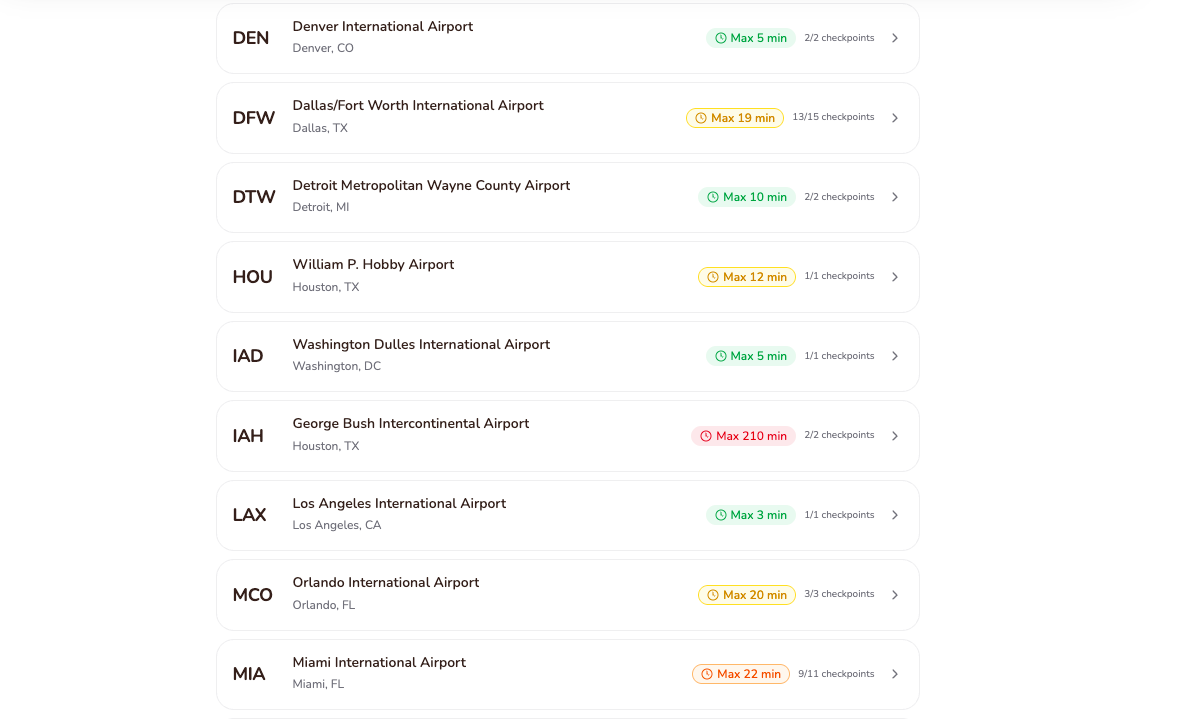
Here's what travelers are seeing at the airports hit hardest by TSA staffing issues. Atlanta reported waits up to six hours in late March, while Houston hit over three hours on Thursday morning.
Chicago runs inconsistently across terminals. Terminal 3 and Terminal 5 international checkpoints move the slowest, with waits regularly topping two hours during peak morning departures. Terminal 1 tends to clear faster, though that changes hour to hour based on staffing.
Philadelphia consolidates checkpoints when officers don't show up. Terminal B and Terminal E have both closed secondary screening areas, pushing everyone through main checkpoints. Departures from Terminal 1 and Terminal E get hit hardest during early morning and late afternoon waves.
Fort Lauderdale's Terminal 3 and Terminal 4 are the problem zones, with both seeing 90-minute waits starting around 5 a.m. Major airports like JFK also face capacity issues. Terminal 4 moves slightly better.
New Orleans, Baltimore/Washington, and SFO all face delays, though not quite as severe. Having lounge access at busy terminals can help you escape the chaos while you hopefully get some time to relax as you wait for your flight.
TSA PreCheck is still cutting wait times, but the advantage isn't as consistent as it used to be. At some airports, PreCheck lanes are closing when too many officers call out sick. When that happens, PreCheck members get funneled into standard security lines alongside everyone else. nextcard's TSA wait times tool shows you current wait times for Priority, CLEAR+, and TSA PreCheck lanes at major airports, so you can see the actual time savings before you arrive.
At airports where TSA PreCheck lanes stay open, you're still looking at major time savings with access. If you haven't signed up yet, many credit cards reimburse the application fee. Orlando International saw general security lines hit 45 minutes while PreCheck topped out around 10 minutes. Philadelphia showed an even bigger gap, with standard lines reaching 28 minutes compared to under five minutes for PreCheck.
The problem is you won't know if your airport is keeping PreCheck lanes open until you get there. Larger hubs like O'Hare and Fort Lauderdale maintain at least one PreCheck checkpoint per terminal during peak hours, but smaller airports are less predictable.
If you already have PreCheck, this is the time to use it. The risk of a closed lane is worth the potential 30 to 40-minute time save. If you're deciding whether to sign up right now, you should strongly consider. Popular credit cards like the United℠ Explorer Card and Chase Sapphire Reserve® offer a statement credit when you get TSA PreCheck with the card. The American Express Platinum Card® has a credit for CLEAR+ if you are looking for ways to save on alternative programs.
The current funding lapse started February 14, 2026, but this isn't TSA's first crisis in recent years. A 43-day shutdown in fall 2025 pushed officers to similar breaking points.
The root problem lies in how DHS funding gets allocated. TSA officers are classified as required but non-exempt employees, which means they must report to work during shutdowns without receiving paychecks. ICE agents, on the other hand, receive salaries because their funding comes from spending accounts that aren't subject to annual appropriations. Both agencies fall under the same department, yet the budget structure treats them entirely differently.
Congressional negotiations continue, though no resolution timeline has been announced. Until funding passes, TSA will keep operating with reduced staff and deteriorating conditions at checkpoints nationwide.
When you're facing unpredictable security lines, real-time data makes all the difference. Our TSA wait times tool pulls live checkpoint information from major airports, letting you see current conditions before you leave for the airport. Filter by specific terminals, compare different checkpoints, and identify timing patterns that help you avoid the worst crowds.
And if you're tracking cards with nextcard, we'll show which ones include airport lounge access and allow guests. After clearing a lengthy security line, having lounge access gives you a place to peacefully relax before your flight. You get comfortable seating, food, drinks, and reliable Wi-Fi while waiting to board.
Many travel cards also include trip delay protection and travel credits that become especially useful during disruptions. With nextcard wallet, we help you identify which benefits apply to your travel situation, including purchase protections, so you can take advantage of your coverage when delays occur.
Monitoring TSA wait times at your departure airport helps you time your arrival better during this unpredictable period. PreCheck and CLEAR+ remain your best options for cutting wait times, but have a backup plan for when lanes close without notice. Choosing terminals with consistently faster checkpoints makes a measurable difference at larger hubs. Extra cushion time helps protect you from missed connections until TSA staffing stabilizes.
Plan to arrive at least 3-4 hours before domestic flights and 4-5 hours before international flights, especially if you're traveling through major hubs like O'Hare, Atlanta, or Fort Lauderdale where wait times regularly exceed two hours during peak periods.
TSA PreCheck still saves time when lanes stay open, often cutting waits from 45 minutes to 10 minutes or less, but some airports close PreCheck checkpoints when too many officers call out sick and funnel everyone into standard security lines.
nextcard's TSA wait times tool pulls from multiple sources to give you a clearer picture, tracking wait times across major airports and terminals with both current conditions and recent trends.
TSA is consolidating officers at certain checkpoints to keep them running during the staffing crisis, which means some terminals run with skeleton crews or close secondary screening areas entirely, creating big differences in wait times between checkpoints at the same airport.
Advertiser Disclosure: nextcard may receive compensation from card issuers. Opinions expressed here are the author's alone, not those of any bank, credit card issuer, airlines or hotel chain. For the most up-to-date terms & conditions, refer to the official credit card application on the issuer's website.
As of today, TSA wait times at airports across the country are much longer than usual. Security lines are highly unpredictable right now. A checkpoint wait time displaying 20 minutes at 6 a.m. can balloon to 90 minutes by 7 a.m. when TSA officers call out during their shift. Over 50,000 TSA agents have been working without pay since mid-February, and the staffing crisis is hitting airports nationwide differently. Delays largely depend on how many officers show up each day. Knowing which terminals and security checkpoints have shorter wait times can mean the difference between making your flight or getting rebooked.
TL;DR:
TSA wait times hit record highs in March 2026, with some airports seeing waits exceed 4 hours.
Over 50,000 TSA officers are working without pay due to a funding lapse that started February 14, 2026.
TSA PreCheck still saves time at most airports, cutting waits from 45 minutes to under 10 minutes.
Check current wait times using nextcard's Live TSA Wait Times tool, which covers major U.S. airports.
Airport security lines across the country are at a breaking point. Some major airports are seeing wait times exceed four hours, with TSA officer callout rates exceeding 40%.
The root cause is a Department of Homeland Security funding lapse that began on February 14, 2026. Over 50,000 TSA officers have been working without pay for weeks, and the impact is severe. Many officers are calling out sick or leaving the agency entirely, creating what officials are calling some of the longest security wait times in TSA history.
This becomes more important during the current staffing crisis. Fewer officers mean slower screening. When you're traveling through airports like O'Hare, Fort Lauderdale, or Philadelphia right now, you're likely facing delays that go well beyond the standard two-hour buffer airlines recommend. Some travelers are missing flights even when they arrive 3 to 5 hours early at the airport.
The MyTSA app typically aggregates checkpoint data from participating airports, allowing you to search by airport code and see estimated wait times.
However, during the current TSA staffing crisis, the app's data may not be reliably updated because fewer TSA officers are available to monitor and report wait times. While the app may show red alerts at airports experiencing severe delays, the information could be outdated or incomplete, making it difficult to know if the information you have is accurate during this shutdown period.
nextcard's Live TSA Wait Times tool pulls from multiple sources to give you a clearer picture. The tool tracks wait times for Priority, CLEAR+, and TSA PreCheck® across major airports and terminals, showing both current conditions and recent trends. This is helpful when you're trying to figure out which checkpoints are consistently slower at your departure airport.
Not all checkpoints are created equal, even at the same airport. At O'Hare, Terminal 5 might show a 15-minute wait while Terminal 3's main checkpoint is backed up for over an hour. The same pattern plays out at Fort Lauderdale, where Terminal 4 consistently moves faster than Terminal 3 during morning rush periods.
Airport | Worst Terminals | Typical Peak Wait | Faster Terminal Option | Peak Hours |
|---|---|---|---|---|
This information is especially useful during the current staffing crisis. TSA is consolidating officers at certain checkpoints to keep them open, which means some terminals are running with skeleton crews or closing secondary checkpoints entirely. Philadelphia's Terminal E, for example, has been shutting down its north checkpoint intermittently, funneling everyone through a single screening area.
If you have flexibility in where you check in, look up terminal specific wait times before you head to the airport. Some airlines operate out of multiple terminals at larger hubs, which can give you options. Even if you're locked into one terminal, knowing which checkpoint tends to move faster can shave 20 to 30 minutes off your wait. nextcard's TSA wait times tool lets you compare wait times across different terminals at the same airport, helping you identify the fastest checkpoint before you leave.
Here's what travelers are seeing at the airports hit hardest by TSA staffing issues. Atlanta reported waits up to six hours in late March, while Houston hit over three hours on Thursday morning.
Chicago runs inconsistently across terminals. Terminal 3 and Terminal 5 international checkpoints move the slowest, with waits regularly topping two hours during peak morning departures. Terminal 1 tends to clear faster, though that changes hour to hour based on staffing.
Philadelphia consolidates checkpoints when officers don't show up. Terminal B and Terminal E have both closed secondary screening areas, pushing everyone through main checkpoints. Departures from Terminal 1 and Terminal E get hit hardest during early morning and late afternoon waves.
Fort Lauderdale's Terminal 3 and Terminal 4 are the problem zones, with both seeing 90-minute waits starting around 5 a.m. Major airports like JFK also face capacity issues. Terminal 4 moves slightly better.
New Orleans, Baltimore/Washington, and SFO all face delays, though not quite as severe. Having lounge access at busy terminals can help you escape the chaos while you hopefully get some time to relax as you wait for your flight.
TSA PreCheck is still cutting wait times, but the advantage isn't as consistent as it used to be. At some airports, PreCheck lanes are closing when too many officers call out sick. When that happens, PreCheck members get funneled into standard security lines alongside everyone else. nextcard's TSA wait times tool shows you current wait times for Priority, CLEAR+, and TSA PreCheck lanes at major airports, so you can see the actual time savings before you arrive.
At airports where TSA PreCheck lanes stay open, you're still looking at major time savings with access. If you haven't signed up yet, many credit cards reimburse the application fee. Orlando International saw general security lines hit 45 minutes while PreCheck topped out around 10 minutes. Philadelphia showed an even bigger gap, with standard lines reaching 28 minutes compared to under five minutes for PreCheck.
The problem is you won't know if your airport is keeping PreCheck lanes open until you get there. Larger hubs like O'Hare and Fort Lauderdale maintain at least one PreCheck checkpoint per terminal during peak hours, but smaller airports are less predictable.
If you already have PreCheck, this is the time to use it. The risk of a closed lane is worth the potential 30 to 40-minute time save. If you're deciding whether to sign up right now, you should strongly consider. Popular credit cards like the United℠ Explorer Card and Chase Sapphire Reserve® offer a statement credit when you get TSA PreCheck with the card. The American Express Platinum Card® has a credit for CLEAR+ if you are looking for ways to save on alternative programs.
The current funding lapse started February 14, 2026, but this isn't TSA's first crisis in recent years. A 43-day shutdown in fall 2025 pushed officers to similar breaking points.
The root problem lies in how DHS funding gets allocated. TSA officers are classified as required but non-exempt employees, which means they must report to work during shutdowns without receiving paychecks. ICE agents, on the other hand, receive salaries because their funding comes from spending accounts that aren't subject to annual appropriations. Both agencies fall under the same department, yet the budget structure treats them entirely differently.
Congressional negotiations continue, though no resolution timeline has been announced. Until funding passes, TSA will keep operating with reduced staff and deteriorating conditions at checkpoints nationwide.
When you're facing unpredictable security lines, real-time data makes all the difference. Our TSA wait times tool pulls live checkpoint information from major airports, letting you see current conditions before you leave for the airport. Filter by specific terminals, compare different checkpoints, and identify timing patterns that help you avoid the worst crowds.
And if you're tracking cards with nextcard, we'll show which ones include airport lounge access and allow guests. After clearing a lengthy security line, having lounge access gives you a place to peacefully relax before your flight. You get comfortable seating, food, drinks, and reliable Wi-Fi while waiting to board.
Many travel cards also include trip delay protection and travel credits that become especially useful during disruptions. With nextcard wallet, we help you identify which benefits apply to your travel situation, including purchase protections, so you can take advantage of your coverage when delays occur.
Monitoring TSA wait times at your departure airport helps you time your arrival better during this unpredictable period. PreCheck and CLEAR+ remain your best options for cutting wait times, but have a backup plan for when lanes close without notice. Choosing terminals with consistently faster checkpoints makes a measurable difference at larger hubs. Extra cushion time helps protect you from missed connections until TSA staffing stabilizes.
Plan to arrive at least 3-4 hours before domestic flights and 4-5 hours before international flights, especially if you're traveling through major hubs like O'Hare, Atlanta, or Fort Lauderdale where wait times regularly exceed two hours during peak periods.
TSA PreCheck still saves time when lanes stay open, often cutting waits from 45 minutes to 10 minutes or less, but some airports close PreCheck checkpoints when too many officers call out sick and funnel everyone into standard security lines.
nextcard's TSA wait times tool pulls from multiple sources to give you a clearer picture, tracking wait times across major airports and terminals with both current conditions and recent trends.
TSA is consolidating officers at certain checkpoints to keep them running during the staffing crisis, which means some terminals run with skeleton crews or close secondary screening areas entirely, creating big differences in wait times between checkpoints at the same airport.
Chicago O'Hare (ORD)
Terminal 3, Terminal 5 (intl) |
2+ hours |
Terminal 1 |
Morning departures |
Fort Lauderdale (FLL) | Terminal 3, Terminal 4 | ~90 min | Terminal 4 (slightly) | From 5 a.m. |

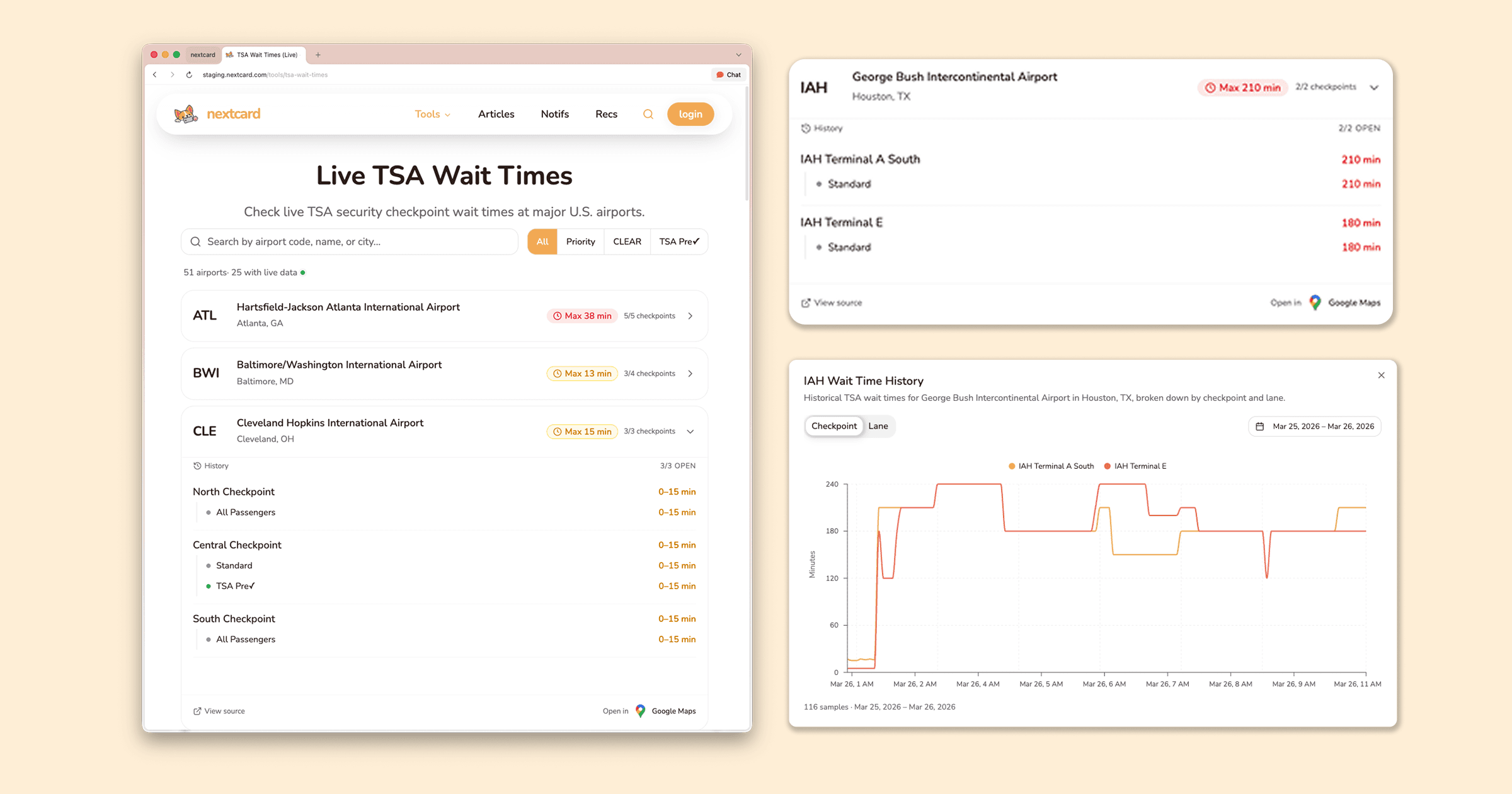
Check live TSA security wait times by airport across the U.S. Search by airport code, airport name, or city.
Interactive tool
Open tool